Nano Banana 2 Lite vs Image 2.5: 틸트시프트 미니어처 하드 대조
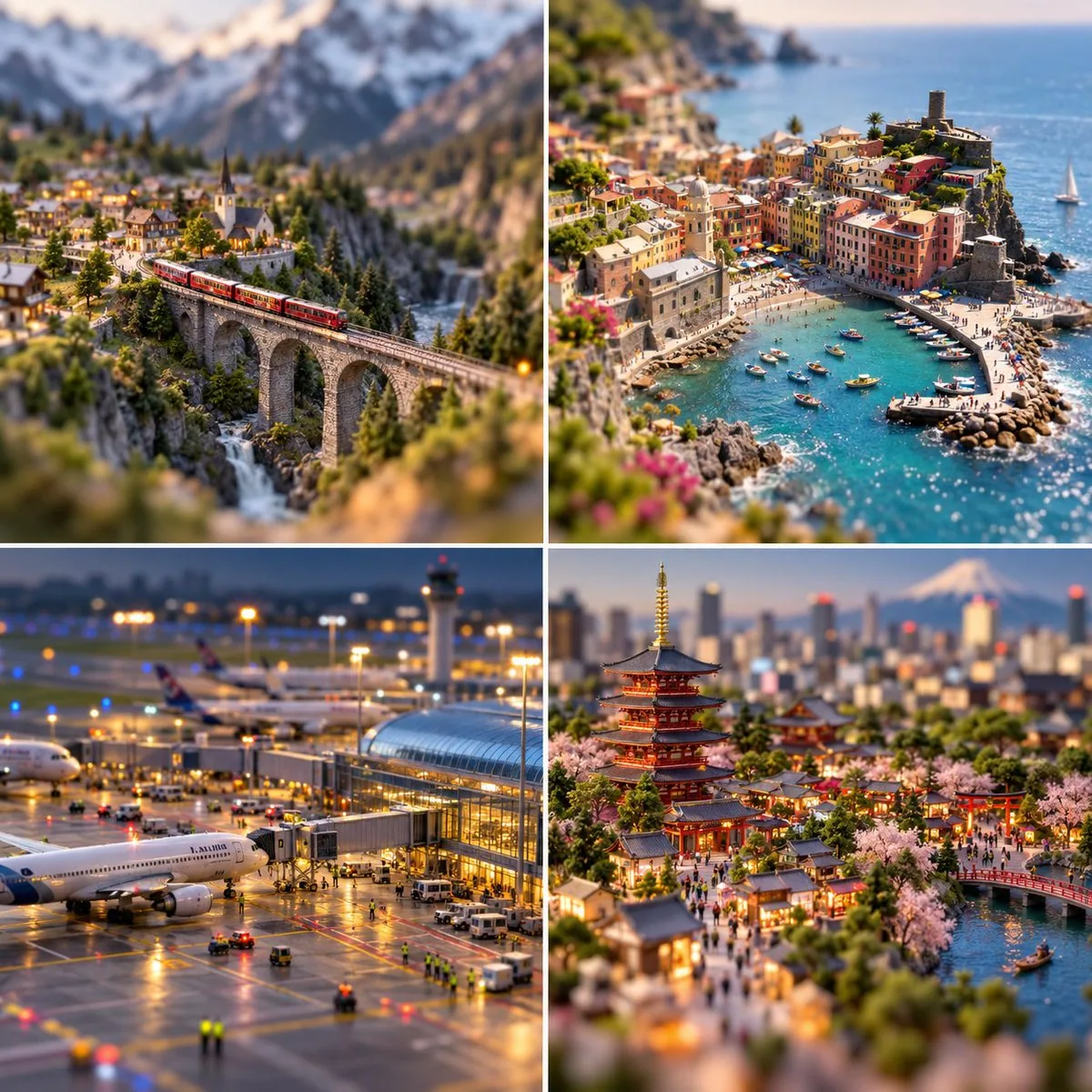
동일 주제 1:1 / 2×2: 한쪽은 프롬프트를 이해하지 못하고, 다른 쪽은 Scheimpflug 틸트시프트 미니어처 콜라주를 내놓습니다. 완전한 INTENT/LAWS/FORBIDDEN 레시피와 함께 모델 선택 화법과 광학 제약을 한 번에 정리했습니다.
프롬프트
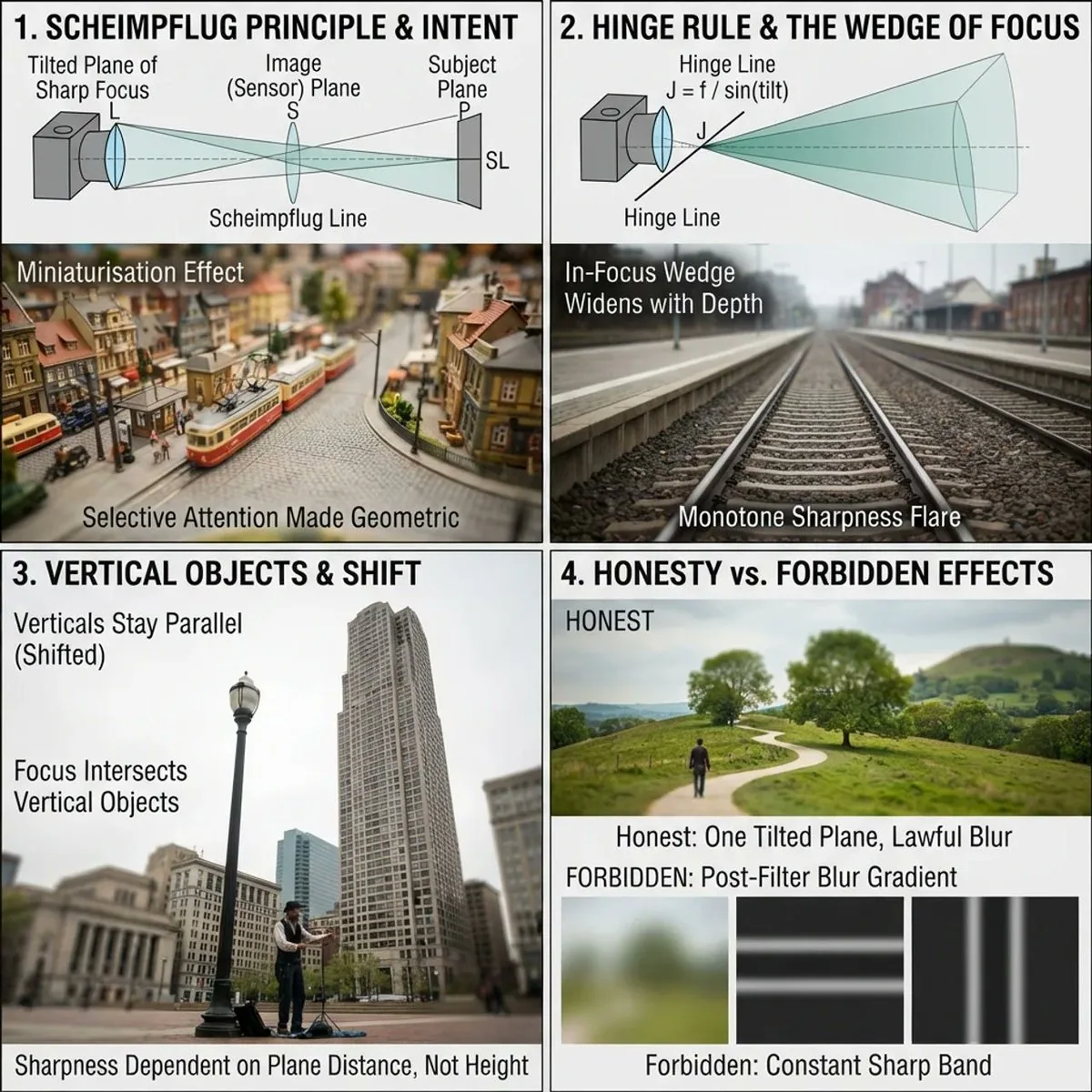
INTENT     selective attention made geometric; miniaturisation, or a slice of focus cutting across the world
UNKNOWNS   tilt angle ;  hinge distance J = f / sin(tilt) ;  aperture N ;  focus distance
LAWS
  Scheimpflug   subject plane, lens plane and image plane extended meet in ONE common line
                ⇒ tilting the lens TILTS the plane of sharp focus in the world
  hinge rule    the focal plane pivots about a hinge line parallel to the lens plane at J below it
                ⇒ the in-focus volume is a WEDGE: zero thickness at the hinge, widening with distance.
                  Near sharp band NARROW, far sharp band WIDE — a lawful, monotone flare.
  the inversion  sharpness is governed by distance FROM THE TILTED PLANE, not by depth.
                ⇒ objects at very different camera distances can be equally sharp if they lie on the plane
                ⇒ objects at the SAME camera distance can differ in sharpness if one sits off it
                (⇒ the "equal depth ⇒ equal blur" FORBIDDEN of the thin-lens prompt is here REVERSED —
                  which is exactly why fake tilt-shift is detectable)
  vertical objects  a lamppost, tower or figure standing across the plane is sharp only in the BAND where
                it intersects, blurring above and below — but that band's HEIGHT varies with its distance
  shift         rise/fall keeps sensor parallel to the façade ⇒ verticals stay PARALLEL while framing high;
                the horizon sits off-centre. Cropping a tilted-up frame instead leaves converging verticals.
  aperture      stopping down widens the wedge; the bokeh still obeys one aperture, one blade count
OVERDETERMINATION   the plane recovered from ≥3 sharp features at differing depths — one plane fits all;
                    the wedge's widening rate must agree with the recovered tilt and N
HONEST      one tilted plane; sharpness monotone in distance from it; the sharp band widens with depth
FORBIDDEN   a blur gradient that is a function of IMAGE HEIGHT rather than of distance from a world plane
            (the post-filter tell: an even soft band top and bottom, ignoring the scene's geometry) ;
            a sharp band of constant width from foreground to horizon (no wedge) ;
            two objects on the same recovered plane, one sharp and one soft ;
            a tall vertical uniformly sharp along its whole height while the plane clearly crosses it ;
            "shifted" architecture with converging verticals, or unshifted verticals with a centred horizon
            that the framing contradicts ;
            miniature-faking by blur and saturation alone with a ground-level viewpoint no model would have.
한국어 번역
INTENT     기하학이 된 선택적 주의; 미니어처화, 또는 세계를 가로지르는 초점의 한 조각
UNKNOWNS   틸트 각도 ;  힌지 거리 J = f / sin(tilt) ;  조리개 N ;  초점 거리
법칙
  샤임플루그   피사체 평면, 렌즈 평면, 이미지 평면을 연장하면 하나의 공통선에서 만난다
                ⇒ 렌즈를 기울이면 세계에서 초점이 맞는 평면이 기울어진다
  힌지 규칙    초점 평면은 렌즈 평면과 평행하고 그 아래 J만큼 떨어진 힌지 선을 축으로 회전한다
                ⇒ 초점이 맞는 부피는 쐐기 모양이다: 힌지에서 두께가 0이고 거리에 따라 넓어진다.
                  가까운 선명 대역은 좁고 먼 선명 대역은 넓다 — 법칙에 따른 단조로운 확산.
  역전  선명도는 깊이가 아니라 기울어진 평면으로부터의 거리가 지배한다.
                ⇒ 카메라 거리가 크게 다른 물체들도 그 평면 위에 있으면 똑같이 선명할 수 있다
                ⇒ 카메라 거리가 같은 물체들도 평면에서 벗어나 있으면 선명도가 달라질 수 있다
                (⇒ 얇은 렌즈 프롬프트의 "같은 깊이 ⇒ 같은 흐림" 금지 규칙은 여기서 뒤집힌다 —
                  이것이 바로 가짜 틸트시프트가 탐지되는 이유다)
  수직 물체  평면을 가로질러 서 있는 가로등, 탑, 인물은 교차하는 대역에서만 선명하고
                위아래는 흐려진다 — 하지만 그 대역의 높이는 거리에 따라 달라진다
  시프트      상승/하강은 센서를 파사드와 평행하게 유지한다 ⇒ 높게 프레이밍해도 수직선은 평행하게 유지되고
                지평선은 중심에서 벗어난다. 대신 위로 기울인 프레임을 크롭하면 수직선이 수렴한다.
  조리개      조리개를 조이면 쐐기가 넓어진다; 보케는 여전히 하나의 조리개, 하나의 날개 수를 따른다
과잉 결정   서로 다른 깊이의 선명한 특징 ≥3개로부터 복원된 평면 — 하나의 평면이 모든 것에 들어맞는다;
                    쐐기가 넓어지는 비율은 복원된 틸트 및 N과 일치해야 한다
정직      기울어진 평면 하나; 그로부터의 거리에 대해 선명도는 단조롭다; 선명 대역은 깊이에 따라 넓어진다
금지   세계 평면으로부터의 거리가 아니라 이미지 높이의 함수인 흐림 그라디언트
            (후처리 필터의 흔적: 장면의 기하를 무시하고 위아래에 균일하게 깔리는 소프트 대역) ;
            전경에서 지평선까지 폭이 일정한 선명 대역 (쐐기 없음) ;
            같은 복원 평면 위의 두 물체 가운데 하나는 선명하고 하나는 흐린 경우 ;
            평면이 분명히 교차하는데도 전체 높이에 걸쳐 균일하게 선명한 높은 수직 물체 ;
            수직선이 수렴하는 "시프트된" 건축물, 또는 프레이밍과 모순되는 중심 지평선을 가진
            시프트되지 않은 수직선 ;
            어떤 모델도 취하지 않을 지면 시점에서 흐림과 채도만으로 미니어처를 흉내 내는 것.
출처
- 원작자
- Gdgtify
- 게시일
- 2026-09-16
- 원문 출처
- 원문 보기 ↗
- 수록 출처
- xianyu110/awesome-gpt-image2.5 · 2100356053095641424 · MIT