比萨斜塔测绘四联:可换城市 master prompt
上半真景、下半 USGS 式等高线测绘重建,四板密度轴可调。换 {STRUCTURE}/{CITY} 就能给自家城市出一套收藏级建筑海报——Sunburst 4K 模板。
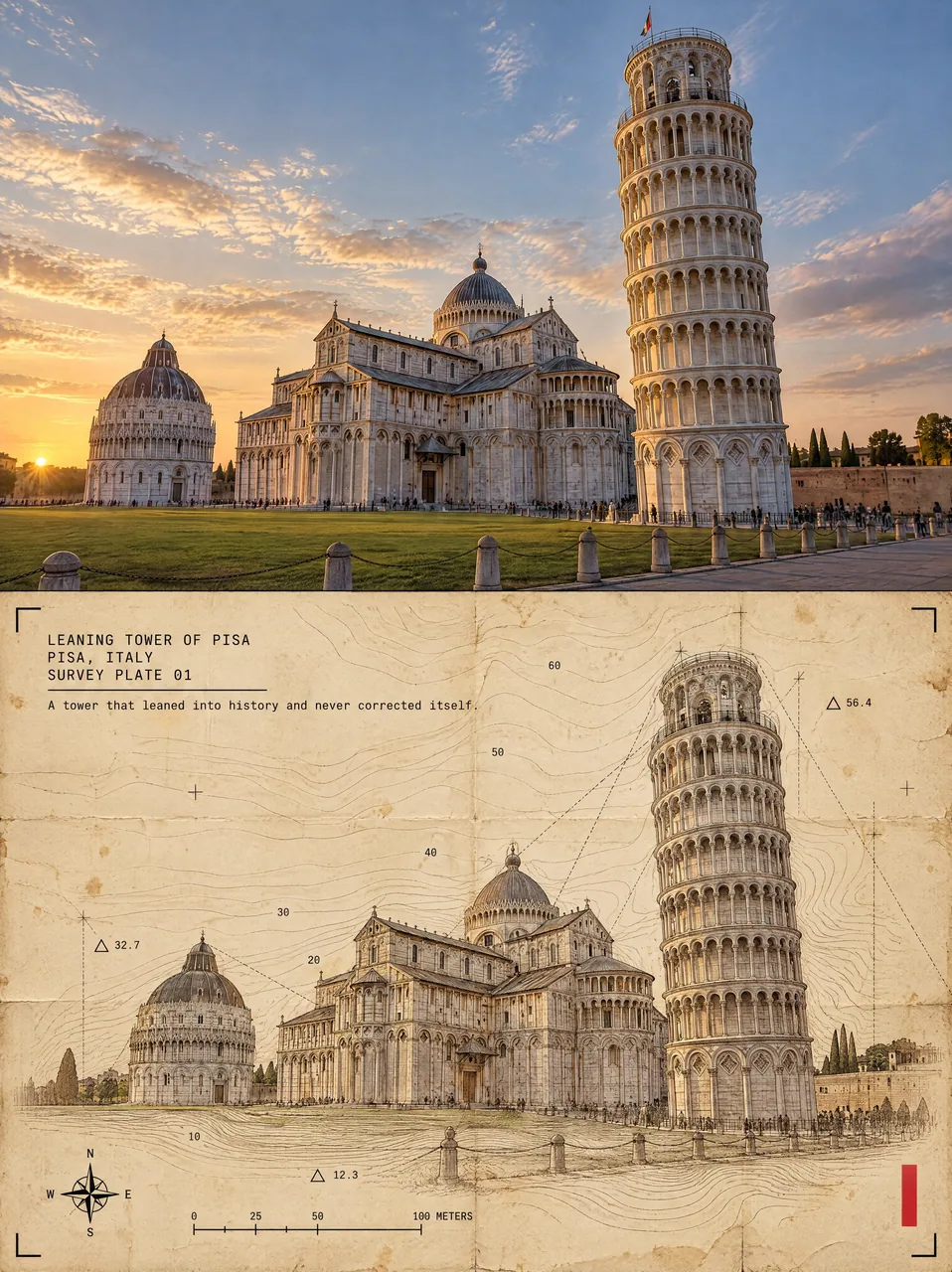
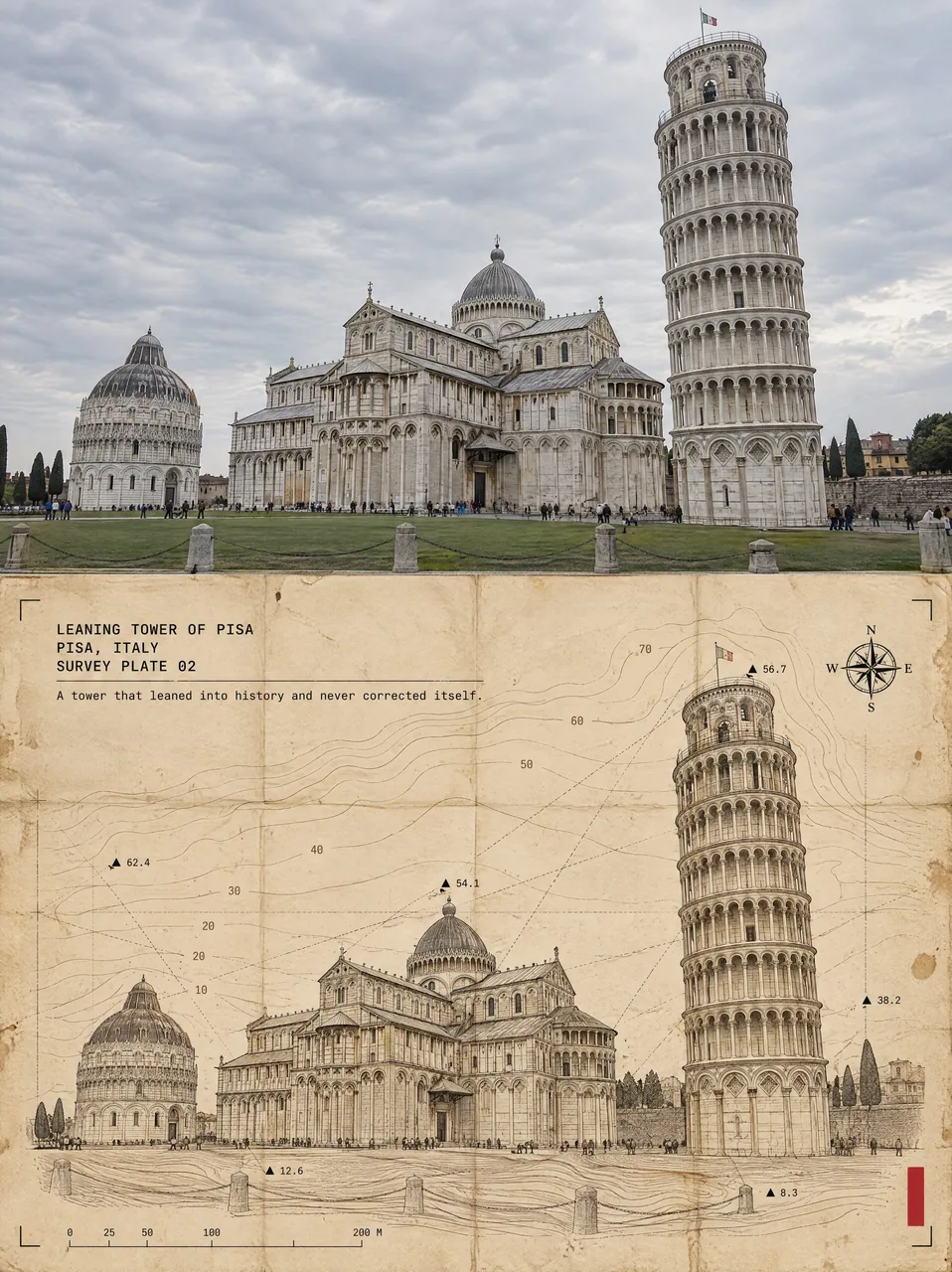
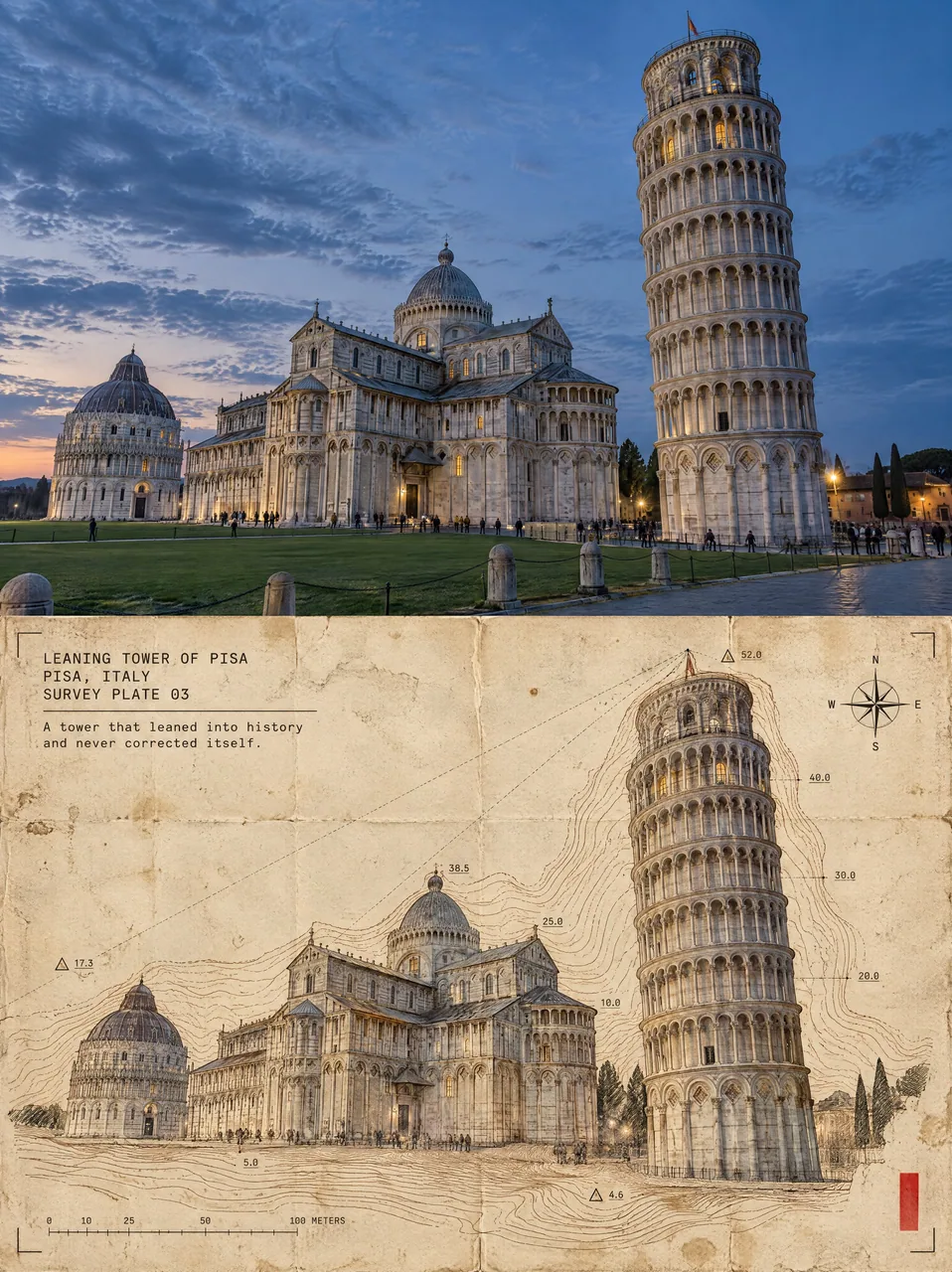
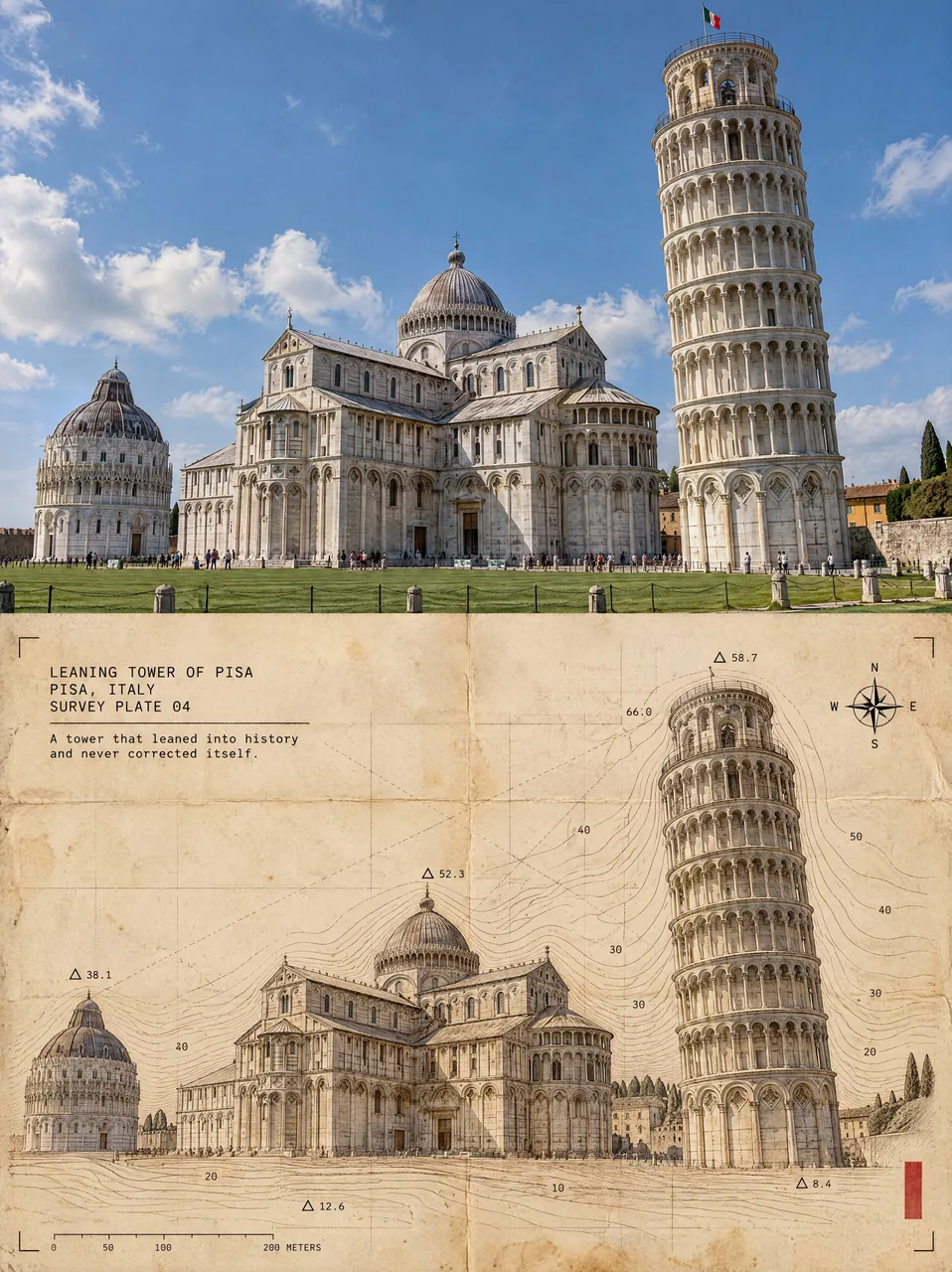
提示词
One poster, 3:4 vertical canvas. Split into two roughly equal zones — a realistic photograph on top, a printed reconstruction below — divided by one clean sharp horizontal line. The structure must not be stretched, warped, tilted or repositioned unnaturally.

TOP HALF — THE REAL SHOT
{STRUCTURE DESCRIPTION}. {PLATE LIGHT}. Preserve the structure faithfully: same architecture, proportions, perspective, distinctive details, natural light and shadow. Add only a subtle high-end color grade and the faintest film grain. Never redesign or reinterpret the architecture.

BOTTOM HALF — THE PRINTED RECONSTRUCTION
Rebuild the same structure as a mid-century surveyor's topographic map sheet: the building and its site rendered in fine brown contour lines that wrap around the mass and terrain, elevation index numbers printed along the contours, small triangular benchmark markers with elevation tags, a compass rose, a thin scale bar, faint theodolite sight-lines and the blocky vintage lettering of a USGS quadrangle sheet. The photograph dissolves outward into contour lines, survey ticks and a faint grid. The structure must remain immediately recognizable. {PLATE DENSITY}.
Texture: yellowed map paper with fiber grain, worn fold creases, faint old stains, restrained crop marks, one small red calibration bar. Color: aged-paper ground, warm brown and black survey inks, the structure's original muted colors, a single red accent. Never fully desaturate the structure.
The structure occupies roughly 60-88% of the frame width. Leave 22-38% of the paper visibly untouched and empty — generous negative space so the poster reads as an archival specimen, not a packed screen.

TYPOGRAPHY — a clean fixed-width architectural title block, pinned top-left at a small fixed inset, black ink, monospaced technical typeface, verbatim, each line in caps:
"{NAME}"
"{CITY, COUNTRY}"
"SURVEY PLATE 0N"
A thin horizontal rule under the third line, then one short observational caption verbatim:
"{CAPTION}"

A solid vertical red rectangle — the only red in the poster — is pinned to the bottom-right corner zone about 12% from the bottom and right edges. Four thin black crop marks sit in the four corners of the bottom half at identical insets. Red bar, crop marks and text block keep exactly the same position and size relative to the frame.

MOOD: field survey notebook crossed with modern travel editorial — the landmark as a place the surveyor has measured. Sophisticated, minimal, tactile, intellectual, slightly mysterious, highly collectible.

AVOID: solid black terminal backgrounds, dense walls of code, cyberpunk neon, excessive decorative glyphs, distorted architecture, impossible geometry, invented architectural details, fake technical specifications, random meaningless symbols, garbled text, extra colors, brand logos, QR codes, watermarks, author credits, tourist-poster clichés.

Priority: preserve the structure's identity and architectural accuracy first. The experimental print treatment enhances the architecture, never hides it.

THE FOUR VARIATIONS (one axis change per plate)

PLATE 01 — DENSE · light: "Golden-hour sunlight with long warm shadows" · density: "The print treatment is at its densest and richest: layered marks, full system detail"
PLATE 02 — LINEWORK · light: "Soft overcast daylight, muted flat tones" · density: "The print is linework-forward: thin drafting lines and technical geometry dominate the reconstruction"
PLATE 03 — FRAGMENT · light: "Blue-hour dusk with cool tones and lit windows glowing" · density: "The print is fragment-forward: torn photographic fragments dominate, with fewer system marks around them"
PLATE 04 — MINIMAL · light: "Bright midday sunlight with crisp shadows" · density: "The print is the minimal plate of the set: sparse marks, maximum untouched paper"

To reuse: replace {STRUCTURE DESCRIPTION}, {NAME}, {CITY, COUNTRY} and {CAPTION}. Keep every other line unchanged.
STACK: GPT Image 2.5 · Sunburst · high · 4K · 3:4
中文译文
一张海报,3:4 竖版画布。分为上下两个大致相等的区域 —— 上方是写实照片,下方是印刷式重构 —— 由一条干净锐利的水平线分隔。结构不得被拉伸、扭曲、倾斜或不自然地重新定位。

上半部分 —— 真实拍摄
{STRUCTURE DESCRIPTION}。{PLATE LIGHT}。忠实保留结构:相同的建筑、比例、透视、独特细节、自然的光影。只添加一层微妙的高端调色与极淡的胶片颗粒。绝不重新设计或重新诠释建筑。

下半部分 —— 印刷式重构
将同一结构重建为一张 20 世纪中叶测绘师的地形图纸:建筑及其场地以细密的棕色等高线绘制,等高线环绕建筑体量与地形;沿等高线印有高程索引数字;带高程标注的小型三角形水准点标记;一个罗盘玫瑰;一条细比例尺;淡淡的水准仪视线;以及 USGS 方幅图那种方正复古的字体。照片向外消融为等高线、测量刻度与一层浅淡网格。结构必须保持一眼可辨。{PLATE DENSITY}。
质感:泛黄的地图纸张,带纤维颗粒、磨损的折痕、淡淡的旧污渍、克制的裁切标记,以及一条小小的红色校准条。颜色:做旧纸张底色、暖棕与黑色的测绘墨水、结构原有的低饱和色彩、单一红色点缀。绝不要把结构完全去饱和。
结构占据画幅宽度约 60-88%。让纸张有 22-38% 明显未被触碰的留白 —— 充裕的负空间,让海报读起来像一件档案标本,而不是塞满的画面。

排版 —— 一个干净等宽的建筑工程标题栏,固定在左上角小幅固定内缩处,黑色墨水,等宽技术字体,逐字照录,每行均大写:
"{NAME}"
"{CITY, COUNTRY}"
"SURVEY PLATE 0N"
第三条线下方一条细水平线,然后一条简短的观察性说明文字,逐字照录:
"{CAPTION}"

一个实心的竖向红色矩形 —— 海报中唯一的红色 —— 固定在右下角区域,距底边和右边各约 12%。四个细黑裁切标记位于下半部分的四个角,内缩距离完全相同。红色色条、裁切标记与文字块相对画幅保持完全一致的位置与大小。

氛围:野外测绘笔记本与现代旅行杂志的混合 —— 把地标视为测绘师测量过的地方。精致、极简、注重质感、理性、略带神秘、极具收藏价值。

避免:纯黑终端背景、密集的代码墙、赛博朋克霓虹、过多的装饰性字形、扭曲的建筑、不可能的几何结构、凭空编造的建筑细节、虚假的技术规格、随机无意义的符号、乱码文字、多余的颜色、品牌 logo、二维码、水印、作者署名、旅游海报的陈词滥调。

优先级:首先要保留结构的识别性与建筑准确性。实验性的印刷处理是增强建筑,绝不遮蔽它。

四种变体(每张图只改变一个轴)

PLATE 01 —— DENSE(密集) · 光线:"黄金时刻的阳光,投下长长的暖调阴影" · 密度:"印刷处理达到最密集、最丰富的程度:层层叠叠的标记,完整的系统细节"
PLATE 02 —— LINEWORK(线稿) · 光线:"柔和的阴天日光,低饱和的平光色调" · 密度:"印刷以线稿为主:细制图线与技术几何主导重构画面"
PLATE 03 —— FRAGMENT(碎片) · 光线:"蓝调时刻的黄昏,冷色调,亮起的窗户透出光" · 密度:"印刷以碎片为主:撕裂的照片碎片主导画面,其周围的系统标记更少"
PLATE 04 —— MINIMAL(极简) · 光线:"明亮的正午阳光,阴影清晰锐利" · 密度:"印刷是该组中最极简的一张:标记稀疏,未触碰的纸张面积最大"

复用方法:替换 {STRUCTURE DESCRIPTION}、{NAME}、{CITY, COUNTRY} 和 {CAPTION}。其余每一行保持不变。
STACK: GPT Image 2.5 · Sunburst · high · 4K · 3:4
溯源
- 原作者
- sebatheepan
- 发布日期
- 2026-09-18
- 原始出处
- 查看原帖 ↗
- 收录来源
- xianyu110/awesome-gpt-image2.5 · 2100914552682450985 · MIT