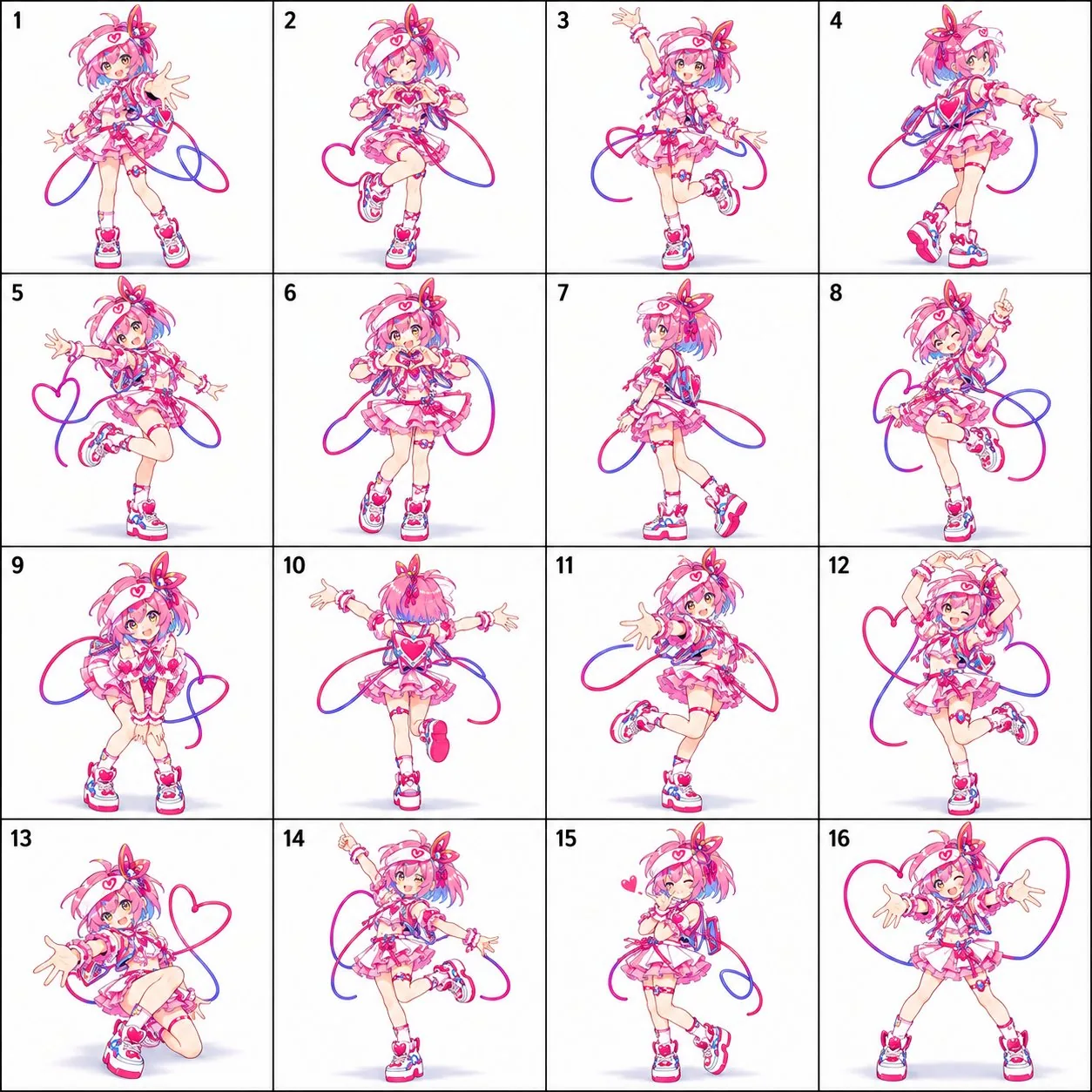
角色自适应 4×4 舞蹈姿态表
上传人设自动选舞风,16 格连贯姿态;可再接视频 prompt 出片。短视频种草/表情包流水线。
提示词
Create a 4×4 dance pose sheet featuring the character in the uploaded reference image, with exactly 16 equally sized panels in one square image.

CHARACTER CONSISTENCY Use the uploaded character as the sole reference for character identity and appearance. Preserve the character’s face, hairstyle, colors, body proportions, species, outfit, accessories, and original art style across all 16 panels. Do not redesign the character or add an idol costume. If any body or costume details are not visible in the reference, infer them conservatively and keep them consistent throughout.

ADAPTIVE CHOREOGRAPHY Design a cohesive dance sequence tailored to this specific character’s personality, appearance, anatomy, clothing, and range of motion.

Choose a suitable dance style automatically: lively for an energetic character, graceful for an elegant character, confident for a bold character, playful for a cute character, or restrained for a serious character. Do not force every character into cute idol poses.  Show 16 distinct key poses from the same dance routine, ordered from left to right and top to bottom. Make the sequence feel connected, with natural transitions and a clear beginning, build-up, climax, and ending.

Use the following movement structure, adapting each action to the character:
1. Opening pose that establishes the character’s personality.
2. Small rhythmic step with a coordinated arm gesture.
3. Side step with one arm extended.
4. Compact expressive gesture near the face or upper body.
5. Grounded stance with arms crossing or sweeping inward.
6. Knee lift or an anatomically appropriate weight shift.
7. Open, expansive pose with arms spread.
8. Playful or expressive balance pose.
9. Turning pose showing a three-quarter rear view.
10. Forward-reaching movement with a diagonal body lean.
11. Strong upward-reaching accent.
12. Climactic jump or a grounded full-body extension if jumping is unsuitable.
13. Lowered stance with a forward gesture.
14. Elegant or dynamic side-facing transition.
15. Signature gesture that suits the character.
16. Confident final pose with a clear finishing silhouette.

COMPOSITION AND PRESENTATION Use a clean white background, thin grid lines, and small readable numbers 1–16 in the upper-left corner of each panel. Include exactly one full-body depiction of the same character per panel. Keep the character’s scale, camera distance, lighting, and rendering style consistent. Use a fixed camera while allowing the character to turn naturally.  Keep the entire character, including hair, ears, horns, wings, tail, hands, feet, and accessories, inside each panel with comfortable margins. Allow room for extended limbs and jumps. Add subtle ground shadows. Show natural secondary movement in hair, fabric, and accessories.  Every pose must have a clear silhouette, convincing balance, anatomically plausible joints, and expressive body language. Adapt all movements to nonhuman anatomy when applicable.

AVOID Repeated or nearly identical poses, character identity drift, costume changes, inconsistent proportions, extra or missing limbs, malformed hands, cropped body parts, overlapping panels, additional characters, motion trails, background scenery, props not present in the reference, speech bubbles, captions, and watermarks.

Final output: one polished square image containing a clearly organized 4×4 grid of 16 distinct, character-appropriate dance poses.
中文译文
创作一张 4×4 舞蹈姿态表,表现上传参考图中的角色,在一张正方形图片中恰好包含 16 个等大的分格。

角色一致性:以上传的角色作为角色身份与外观的唯一参考。在全部 16 个分格中保持角色的面部、发型、配色、身体比例、物种、服装、配饰以及原有的艺术风格。不要重新设计角色,也不要添加偶像服装。如果参考图中看不到某些身体或服装细节,请保守地推断,并在整个过程中保持一致。

自适应编舞:为这个特定角色的性格、外观、解剖结构、服装和动作幅度量身设计一段连贯的舞蹈。

自动选择合适的舞蹈风格:精力充沛的角色用活泼风格,优雅的角色用优美风格,大胆的角色用自信风格,可爱的角色用俏皮风格,严肃的角色用克制风格。不要强迫每个角色都摆出可爱的偶像姿势。展示同一段舞蹈中的 16 个不同关键姿态,按从左到右、从上到下的顺序排列。让整段序列感觉连贯,转场自然,并有清晰的开场、推进、高潮和结尾。

使用以下动作结构,并将每个动作适配到角色:
1. 确立角色性格的开场姿态。
2. 带有协调手臂动作的小幅节奏步伐。
3. 向侧方迈步,一只手臂伸展。
4. 靠近面部或上半身的紧凑、富有表现力的手势。
5. 双臂交叉或向内横扫的扎实站姿。
6. 抬膝,或在解剖上合理的重心转移。
7. 双臂展开、开阔张扬的姿态。
8. 俏皮或富有表现力的平衡姿态。
9. 展现四分之三背面视角的转身姿态。
10. 身体斜向倾斜的向前伸展动作。
11. 有力的向上伸展重音。
12. 高潮式跳跃;若不适合跳跃,则改为扎实的全身延展。
13. 身体下沉、带向前手势的站姿。
14. 优雅或动感的侧向转身过渡。
15. 适合该角色的标志性手势。
16. 轮廓收束清晰、自信的最终姿态。

构图与呈现:使用干净的白色背景、细网格线,并在每个分格左上角标注清晰易读的小号数字 1–16。每个分格中只包含同一个角色的全身形象,且恰好一个。保持角色的比例、镜头距离、灯光和渲染风格一致。使用固定机位,同时允许角色自然转身。让整个角色(包括头发、耳朵、角、翅膀、尾巴、双手、双脚和配饰)都完整位于每个分格内,并留有舒适的边距。为伸展的肢体和跳跃留出空间。添加细微的地面阴影。表现头发、布料和配饰自然的次级动态。每个姿态都必须有清晰的剪影、可信的平衡、解剖上合理的关节以及富有表现力的肢体语言。在适用时,将所有动作适配到非人类解剖结构。

避免:重复或几乎相同的姿态、角色身份漂移、服装变化、比例不一致、多余或缺失的肢体、畸形的手、被裁切的身体部位、分格重叠、额外角色、运动残影、背景景物、参考图中不存在的道具、对话气泡、字幕和水印。

最终输出:一张精致的正方形图片,包含一个组织清晰的 4×4 网格,共 16 个互不相同、贴合角色的舞蹈姿态。
溯源
- 原作者
- Mayz1169
- 发布日期
- 2026-09-14
- 原始出处
- 查看原帖 ↗
- 收录来源
- xianyu110/awesome-gpt-image2.5 · 2099457417528692871 · MIT