Create a 20.00-second kinetic typography film titled “ESCAPE THE ORBIT,” based on John F. Kennedy’s Rice University address, September 12, 1962.

The central experience: a sentence discovers that it can change its own trajectory.

Deliver one complete, self-contained HTML file. Composition: 1080×1080. Target: 60fps. Use Canvas, SVG, or embedded WebGL. Embed required assets and libraries. The film must work without audio.

EXACT DISPLAY TEXT
“We choose to go to the moon”
“[…]”
“not because they are easy,”
“but because they are hard”
Preserve this order. The bracketed ellipsis explicitly indicates omitted speech. Attribution is separate from the excerpt. No additional slogans.
ART DIRECTION
Background: midnight # 080D23.
Primary type: warm white # FFF4DD.
Trajectory: electric coral # FF654F.
Secondary orbital geometry: blue # 6685FF.
Use a broad, confident grotesque for the speech and a sharply drawn italic for the final emphatic word. Avoid the appearance of a spacecraft dashboard. No rockets, astronaut illustrations, starfield wallpaper, lens flares, or decorative telemetry.
The frame should resemble an exceptionally refined astronomical instrument that has become expressive.

CENTRAL VISUAL RULE
The baseline of the sentence is a trajectory.

At first it is trapped in a closed orbit. A rhetorical decision changes that orbit into an open path. The letters remain the same travelers throughout.
Use an abstract orbital metaphor; do not present invented mission data or imply a physically accurate flight simulation.
STORYBOARD
0.00–3.50
The opening excerpt appears across the center, large and horizontal. Reveal it in three meaningful phrase groups.
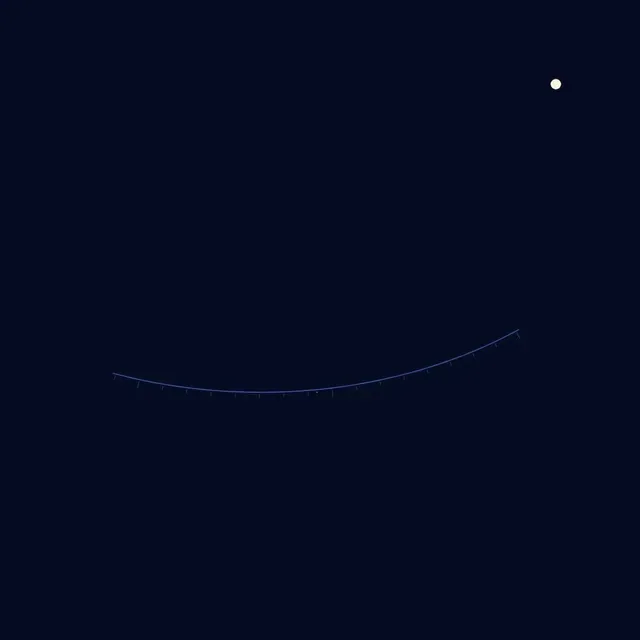
A single hairline ellipse passes behind the baseline. A small circular lunar mark occupies its distant focus.
Hold the completed phrase motionless for 700ms.

3.50–6.00
The camera pulls back. The previously straight baseline reveals a shallow curvature.

The phrase travels along the ellipse as a coherent unit. Keep its glyphs upright during the initial movement. Only after the reading hold may they progressively adopt the tangent of the path.

The viewer realizes the sentence is circling rather than advancing.
6.00–7.00
Show the bracketed omission in an uncluttered central opening. The orbital movement decelerates.

7.00–10.50
Reveal the next clause on the near side of the orbit. Its final word travels through one smooth, effortless arc and returns toward where it started.

This ease should feel elegant but unproductive. Avoid comic bouncing.

10.50–14.50
Reveal the final clause horizontally before transforming it.
At its emphasis, the ellipse opens at one precise point. The same tracked letter group takes the new tangent and departs.
Perform one deliberate 70-degree camera roll. Counter-rotate the active phrase so it remains readable while the orbital field changes orientation around it.

The trajectory sweeps from lower left to upper right. Acceleration is conveyed by expanding spacing between its trailing marks, not by shaking the camera.

14.50–17.00
The camera matches the departing phrase’s velocity. The phrase becomes visually still while the old orbit recedes beneath it.

The lunar mark enlarges into a restrained crescent through geometric overlap. The crescent brackets the destination without becoming a cartoon illustration.
17.00–20.00
Resolve into a spacious editorial composition containing the selected excerpt in reading order, including its omission marker.

The open trajectory runs through the margins and exits the frame. Hold the entire image completely still for the final 1.2 seconds.

CHOREOGRAPHY
Use only three camera operations: pullback, roll, velocity match.
Give each operation a rhetorical purpose.
Keep the currently read phrase at least 64px high in the 1080px composition.
Motion blur may affect trailing geometry, never the active text.
No word may begin its ornamental travel before its reading hold finishes.

IMPLEMENTATION
Represent the ellipse and departure path analytically. Blend position and tangent continuously at the departure point; no teleportation.
Use arc-length sampling for consistent spacing along curves.
Separate camera transforms from glyph orientation.
Cache glyph rendering and static geometry.
Expose window.ready and window. seek(t). Seeking must pause playback and render any time from 0 through 20 deterministically, including out-of-order calls.
Provide window.frame(n) for n=0…1199 at t=n/60.
Render t=20 as the final held composition.
Use no accumulated physics or runtime randomness.

QUALITY GATE
Inspect frames at 0, 3, 5, 7.5, 10.5, 13, 16, and 19 seconds.
Verify that the same tracked phrase visibly follows its own trajectory.
日本語訳
「ESCAPE THE ORBIT」と題した、20.00秒のキネティック・タイポグラフィ映像を制作してください。1962年9月12日のジョン・F・ケネディによるライス大学での演説に基づく作品です。

中心となる体験:ある一文が、自分自身の軌道を変えられることに気づく。

完全に自己完結したHTMLファイルを1つ納品してください。コンポジション:1080×1080。目標:60fps。Canvas、SVG、または埋め込みWebGLを使用。必要なアセットとライブラリは埋め込むこと。映像は音声なしで動作すること。

表示テキスト(厳守)
“We choose to go to the moon”
“[…]”
“not because they are easy,”
“but because they are hard”
この順序を保つこと。括弧付きの省略記号は、発話が省略されていることを明示的に示す。クレジットは抜粋とは別に扱う。スローガンの追加は禁止。
アートディレクション
背景:ミッドナイト # 080D23。
主要書体:ウォームホワイト # FFF4DD。
軌道:エレクトリックコーラル # FF654F。
副次的な軌道幾何学:ブルー # 6685FF。
演説には幅が広く自信に満ちたグロテスク体を、最後の強調語には鋭く描かれたイタリック体を使うこと。宇宙船のダッシュボードのような見た目は避ける。ロケット、宇宙飛行士のイラスト、星空の壁紙、レンズフレア、装飾的なテレメトリーは禁止。
フレームは、極めて洗練された天文機器が自ら表現を獲得したかのような姿であるべき。

中心となる視覚ルール
一文のベースラインは軌道である。

最初、それは閉じた軌道に囚われている。修辞的な決断がその軌道を開かれた経路へと変える。文字は最後まで同じ旅人であり続ける。
抽象的な軌道のメタファーを用いること。捏造したミッション・データを示したり、物理的に正確な飛行シミュレーションであるかのように示唆したりしてはならない。
絵コンテ
0.00–3.50
冒頭の抜粋が画面中央に大きく水平に現れる。意味のある3つのフレーズ・グループに分けて現す。
細いヘアラインの楕円がベースラインの背後を通る。小さな円形の月のマークがその遠い焦点を占める。
完成したフレーズを700ms動かさずに保持する。

3.50–6.00
カメラが引く。これまでまっすぐだったベースラインに、浅い湾曲が現れる。

フレーズはまとまりのある単位として楕円に沿って進む。最初の移動の間は、グリフを直立させたままにすること。読むための保持が終わってから初めて、グリフは徐々に経路の接線を取る。

鑑賞者は、その一文が前進しているのではなく周回していることに気づく。
6.00–7.00
括弧付きの省略を、雑多な要素のない中央の開口部に示す。軌道運動は減速する。

7.00–10.50
次の節を軌道の手前側に現す。その最後の語は、ひとつの滑らかで労力のかからない弧を描いて進み、出発した場所へと戻る。

この心地よさは、優雅でありながら生産的でないと感じられるべき。コミカルな跳ね返りは避ける。

10.50–14.50
最後の節を水平に現してから変換する。
その強調点で、楕円がひとつの正確な点で開く。同じトラッキングされた文字群が新しい接線を取り、出発する。
意図的な70度のカメラ・ロールを1回行う。軌道の場がその周囲で向きを変える間も読みやすく保てるよう、アクティブなフレーズを逆回転させる。

軌道は左下から右上へと掃引する。加速は、カメラを揺らすのではなく、後続のマーク間の間隔を広げることで表現する。

14.50–17.00
カメラは出発するフレーズの速度に合わせる。フレーズは視覚的に静止し、その下で古い軌道が遠ざかる。

月のマークは幾何学的な重なりによって、抑制の効いた三日月へと拡大する。三日月は目的地を括弧で囲むが、漫画的なイラストにはならない。
17.00–20.00
選ばれた抜粋を読み順に、その省略記号も含めて配置した、余白の広いエディトリアルなコンポジションへと収束する。

開かれた軌道はマージンを通り抜け、フレームの外へ出る。最後の1.2秒間、画像全体を完全に静止させる。

振り付け
カメラ操作は、引き(プルバック)、ロール、速度合わせの3つだけを使う。
各操作には修辞的な目的を与えること。
現在読まれているフレーズは、1080pxのコンポジション内で高さ64px以上を保つこと。
モーションブラーは後続の幾何学にのみ影響してよく、アクティブなテキストには決して影響してはならない。
どの語も、その読むための保持が終わる前に装飾的な移動を始めてはならない。

実装
楕円と出発経路は解析的に表現する。出発点で位置と接線を連続的にブレンドすること。テレポートは禁止。
曲線に沿った一貫した間隔のために、弧長サンプリングを用いる。
カメラの変換とグリフの向きは分離する。
グリフのレンダリングと静的な幾何学はキャッシュする。
window.ready と window.seek(t) を公開する。シークは再生を一時停止し、0から20までの任意の時刻を、順不同の呼び出しも含めて決定論的に描画しなければならない。
t=n/60 における n=0…1199 のために window.frame(n) を提供する。
t=20 は最後の保持されたコンポジションとして描画する。
蓄積される物理演算や実行時の乱数は使わない。

品質ゲート
0、3、5、7.5、10.5、13、16、19秒のフレームを検査する。
同じトラッキングされたフレーズが、目に見えて自身の軌道に沿っていることを確認する。