<inputs>
Ask me for: the one question a user asks my product and its one-line answer, two album covers, a royalty-free song around 110 BPM with a quiet intro and a hard drop (Mixkit, free for commercial use), and my logo for the ending. If I skip any, use the defaults: "is this all code?" / "yes. every frame.", two atmospheric photos, Mixkit "Head Bang".
</inputs>

<direction>
A 22 second square loop, 1440x1440 at 60fps, 2D only, one continuous take. Nothing ever cuts: every scene grows out of the last, and every gesture physically carries the camera into the next world. Every morph glides for 0.8s on cubic-bezier(.45,0,.15,1) and the camera zoom rides the same curve, so shapes change so smoothly you barely notice. Content dissolves in the back half of each glide. One gesture per scene.
Look: a warm light stage (#f3f3f0 to #e3e3de), black UI, the app world dark (#121212) tinted from the current album cover, one green accent (#1ed760). Geist for UI, the real macOS pointer, soft layered shadows that grow with the shape's height.
Banned: hard cuts, bouncy springs, particles, glows, zooming in and straight back out, holds longer than 1s, anything that looks like a template.
</direction>

<structure>
Beats are the song's, and the press lands on its drop.
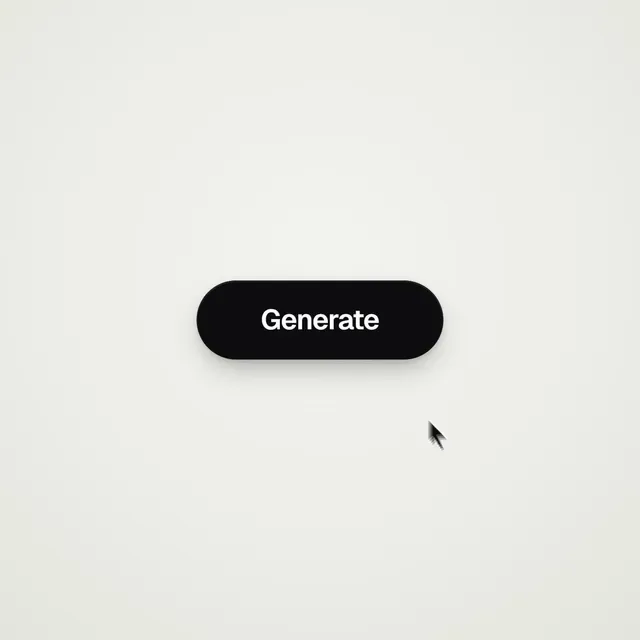
Generate: the cursor clicks, the pill glides into a spinner, then a check.
Chat: the check splits into three typing dots (goo). The left dot flies up into the question bubble and types it, the right one flies down into the reply. Both contract back into dots while gliding in and pour into the middle one.
Play: the middle dot bends into a play triangle, point by point. The cursor presses it on the drop: a white button pops in under the click and the dark app floods out around it, so the leftover white becomes the play button. The camera pulls back to reveal the full now-playing screen: big cover, title, heart (liked, fills green), progress, controls, volume.
Swipe: the cursor drags the cover sideways, the next track slides in, and the whole app retints from the new cover.
Drag: the camera glides to the volume. The cursor drags it to max and keeps pulling: the bar rubber-bands and drags the camera sideways out of the app, tracking the knob across a dark dotted canvas.
Chart: the line lands and bends up into a green chart while the number counts up. The volume knob becomes its last point.
Dive: the cursor clicks that point and the camera dives into it until the light stage fills the frame.
Ending: an "Ask [my product]" button grows out of the light, thins into a line, and the line fans out into my logo (default: the Claude spark, six copies rotating into twelve rays in Claude orange). It folds back into the line, which thickens into Generate. Last frame = first frame.
</structure>
中文译文
<inputs>
向我询问:用户会问我的产品的那一个问题及其一句话回答、两张专辑封面、一首约 110 BPM、前奏安静且 drop 强烈的免版税歌曲(Mixkit,可免费商用),以及我用于结尾的 logo。如果我跳过了任何一项,就使用这些默认值:“is this all code?” / “yes. every frame.”、两张氛围照片、Mixkit 的 “Head Bang”。
</inputs>

<direction>
一个 22 秒的方形循环,1440x1440,60fps,仅 2D,一个连续长镜头。绝没有任何切换:每个场景都从上一个生长出来,每个动作都从物理上把镜头带入下一个世界。每次形变都以 0.8s 沿 cubic-bezier(.45,0,.15,1) 滑行,镜头缩放也沿同一条曲线,因此形状变化平滑到你几乎察觉不到。内容在每次滑行的后半段溶解。每个场景一个动作。
视觉:一个温暖的浅色舞台(#f3f3f0 到 #e3e3de)、黑色 UI、暗色的应用世界(#121212)以当前专辑封面染色、一种绿色强调色(#1ed760)。UI 使用 Geist,真实的 macOS 指针,随形状高度而增强的柔和分层阴影。
禁止:硬切、弹跳弹簧、粒子、发光、放大后立刻缩回、超过 1s 的停留、任何看起来像模板的东西。
</direction>

<structure>
节拍属于歌曲,按下动作落在它的 drop 上。
生成:光标点击,胶囊滑入并变成加载转圈,然后变成一个对勾。
聊天:对勾分裂成三个输入中圆点(goo)。左边的圆点向上飞入问题气泡并输入问题,右边的圆点向下飞入回复。两者在滑入时收缩回圆点,并汇入中间的圆点。
播放:中间的圆点逐点弯折成播放三角形。光标在 drop 上按下它:一个白色按钮在点击处下方弹出,暗色应用从四周涌入,于是剩下的白色便成为播放按钮。镜头后拉,露出完整的正在播放界面:大封面、标题、心形(已喜欢,填充绿色)、进度、控制按钮、音量。
滑动:光标将封面横向拖拽,下一首曲目滑入,整个应用根据新封面重新染色。
拖拽:镜头滑向音量。光标将它拖到最大并继续拉:进度条橡皮筋式拉伸,将镜头横向拖出应用,跟随旋钮穿过暗色点阵画布。
图表:线条落下并向上弯成绿色图表,同时数字递增。音量旋钮成为它的最后一个点。
俯冲:光标点击那个点,镜头俯冲进去,直到浅色舞台填满画面。
结尾:一个 “Ask [my product]” 按钮从光中生长出来,变细成一条线,这条线再展开成我的 logo(默认:Claude 火花,六份副本旋转成十二道 Claude 橙色的光芒)。它折回成那条线,线条变粗成为 Generate。最后一帧 = 第一帧。
</structure>