信息圖可視化設計
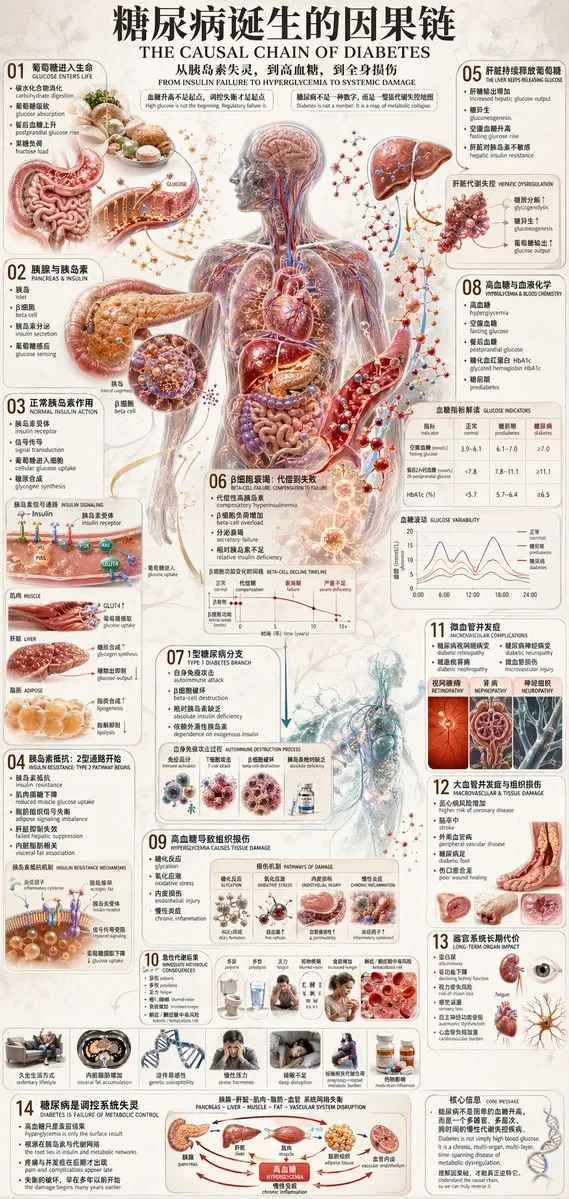
提示詞
{
  "type": "medical infographic poster",
  "style": "highly detailed anatomical illustrations, clean structured layout, scientific diagrammatic style",
  "color_palette": "{argument name=\"color palette\" default=\"medical red, blue, beige, and anatomical flesh tones\"}",
  "language": "{argument name=\"language\" default=\"bilingual Chinese and English\"}",
  "header": {
    "main_title": "{argument name=\"main title\" default=\"糖尿病诞生的因果链\"}",
    "english_title": "{argument name=\"english title\" default=\"THE CAUSAL CHAIN OF DIABETES\"}",
    "subtitle": "从胰岛素失灵,到高血糖,到全身损伤"
  },
  "layout": {
    "centerpiece": "{argument name=\"central subject\" default=\"transparent human body showing circulatory system and internal organs\"}",
    "sections_count": 14,
    "sections": [
      { "id": "01", "title": "葡萄糖进入生命", "visuals": ["stomach and intestines"] },
      { "id": "02", "title": "胰腺与胰岛素", "visuals": ["pancreas", "beta cell"] },
      { "id": "03", "title": "正常胰岛素作用", "visuals": ["receptor signaling diagram", "muscle, liver, adipose icons"] },
      { "id": "04", "title": "胰岛素抵抗: 2型通路开始", "visuals": ["receptor blockage diagram", "7 lifestyle icons"] },
      { "id": "05", "title": "肝脏持续释放葡萄糖", "visuals": ["liver"] },
      { "id": "06", "title": "β细胞衰竭: 代偿到失败", "visuals": ["beta-cell decline line chart"] },
      { "id": "07", "title": "1型糖尿病分支", "visuals": ["autoimmune destruction diagram"] },
      { "id": "08", "title": "高血糖与血液化学", "visuals": ["blood vessel with glucose", "glucose indicators table", "glucose variability chart"] },
      { "id": "09", "title": "高血糖导致组织损伤", "visuals": ["4 pathways of damage diagrams"] },
      { "id": "10", "title": "急性代谢后果", "visuals": ["7 symptom icons"] },
      { "id": "11", "title": "微血管并发症", "visuals": ["eye", "kidney", "nerve cross-section"] },
      { "id": "12", "title": "大血管并发症与组织损伤", "visuals": ["heart", "brain", "diabetic foot"] },
      { "id": "13", "title": "器官系统长期代价", "visuals": ["text list"] },
      { "id": "14", "title": "糖尿病是调控系统失灵", "visuals": ["metabolic control flowchart"] }
    ],
    "footer": {
      "core_message": "核心信息 CORE MESSAGE"
    }
  }
}
中文翻譯
{
  "type": "醫學信息圖海報",
  "style": "高度精細的解剖插圖,清晰的結構化佈局,科學圖解風格",
  "color_palette": "{argument name=\"color palette\" default=\"medical red, blue, beige, and anatomical flesh tones\"}",
  "language": "{argument name=\"language\" default=\"bilingual Chinese and English\"}",
  "header": {
    "main_title": "{argument name=\"main title\" default=\"糖尿病誕生的因果鏈\"}",
    "english_title": "{argument name=\"english title\" default=\"THE CAUSAL CHAIN OF DIABETES\"}",
    "subtitle": "從胰島素失靈,到高血糖,到全身損傷"
  },
  "layout": {
    "centerpiece": "{argument name=\"central subject\" default=\"transparent human body showing circulatory system and internal organs\"}",
    "sections_count": 14,
    "sections": [
      { "id": "01", "title": "葡萄糖進入生命", "visuals": ["胃與腸道"] },
      { "id": "02", "title": "胰腺與胰島素", "visuals": ["胰腺", "β細胞"] },
      { "id": "03", "title": "正常胰島素作用", "visuals": ["受體信號傳導示意圖", "肌肉、肝臟、脂肪組織圖標"] },
      { "id": "04", "title": "胰島素抵抗: 2型通路開始", "visuals": ["受體阻斷示意圖", "7 個生活方式圖標"] },
      { "id": "05", "title": "肝臟持續釋放葡萄糖", "visuals": ["肝臟"] },
      { "id": "06", "title": "β細胞衰竭: 代償到失敗", "visuals": ["β細胞衰退折線圖"] },
      { "id": "07", "title": "1型糖尿病分支", "visuals": ["自身免疫破壞示意圖"] },
      { "id": "08", "title": "高血糖與血液化學", "visuals": ["含葡萄糖的血管", "血糖指標表", "血糖波動曲線圖"] },
      { "id": "09", "title": "高血糖導致組織損傷", "visuals": ["4 條損傷通路示意圖"] },
      { "id": "10", "title": "急性代謝後果", "visuals": ["7 個症狀圖標"] },
      { "id": "11", "title": "微血管併發症", "visuals": ["眼睛", "腎臟", "神經橫截面"] },
      { "id": "12", "title": "大血管併發症與組織損傷", "visuals": ["心臟", "大腦", "糖尿病足"] },
      { "id": "13", "title": "器官系統長期代價", "visuals": ["文字列表"] },
      { "id": "14", "title": "糖尿病是調控系統失靈", "visuals": ["代謝調控流程圖"] }
    ],
    "footer": {
      "core_message": "核心信息 CORE MESSAGE"
    }
  }
}
模板變數
該提示詞含可替換參數,方括號內為預設值
color palette = medical red, blue, beige, and anatomical flesh toneslanguage = bilingual Chinese and Englishmain title = 糖尿病诞生的因果链english title = THE CAUSAL CHAIN OF DIABETEScentral subject = transparent human body showing circulatory system and internal organs
溯源
- 原作者
- hx831126
- 原始出處
- 查看原帖 ↗
- 收錄來源
- freestylefly/awesome-gpt-image-2 · 67 · MIT