Create a Nature Medicine style statistical results figure, landscape 3:2 (1536×1024), soft, restrained, publication-quality.

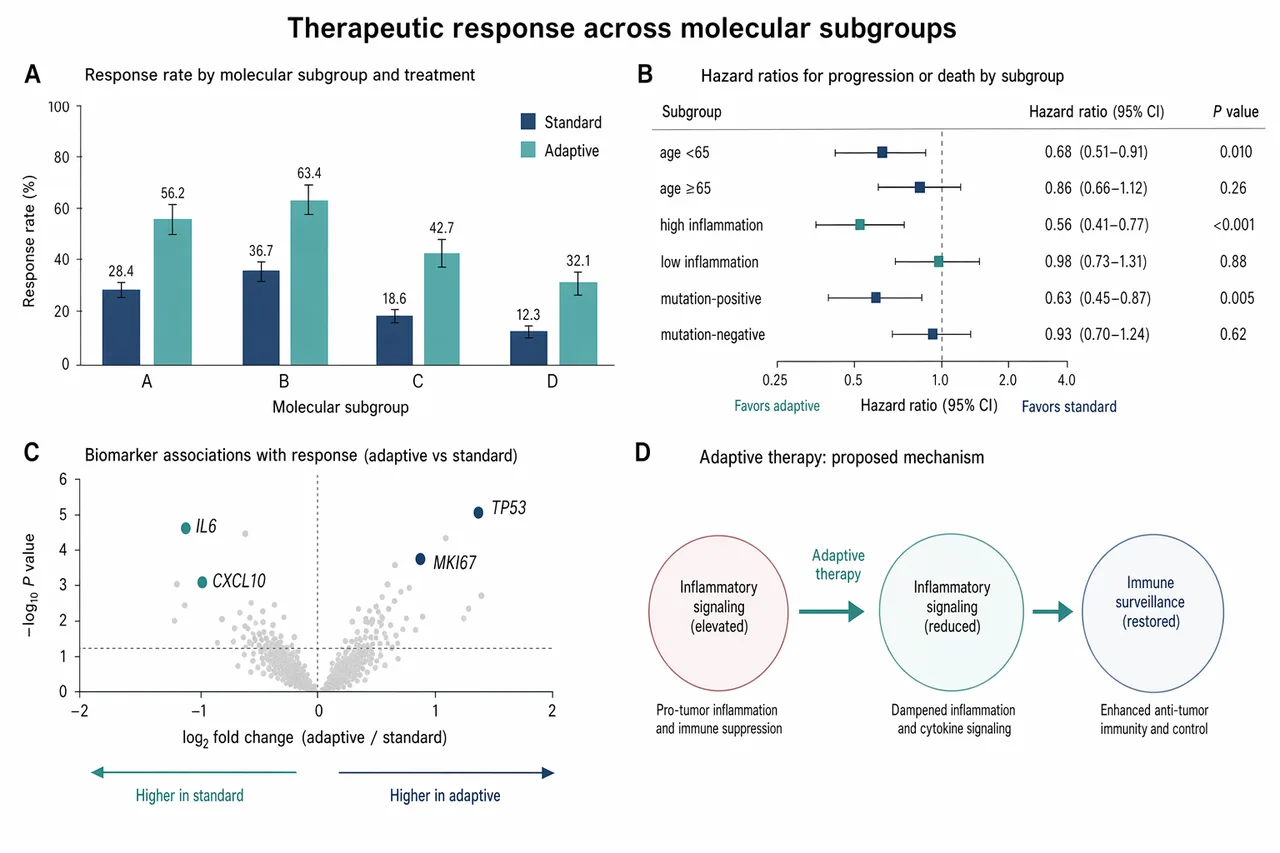
Figure title: "Therapeutic response across molecular subgroups".

Layout: 4-panel figure labeled A–D.
A. Grouped bar chart: response rate (%) for four subgroups "A", "B", "C", "D" across two treatments "standard" and "adaptive". Use muted navy and soft teal bars, thin error bars, numeric labels.
B. Forest plot of hazard ratios for subgroups with a vertical reference line at HR=1.0; rows "age <65", "age ≥65", "high inflammation", "low inflammation", "mutation-positive", "mutation-negative". Use small squares and confidence intervals.
C. Volcano-style biomarker association plot with pale gray background points and highlighted labeled markers "IL6", "CXCL10", "TP53", "MKI67".
D. Minimal mechanism schematic: adaptive therapy reduces inflammatory signaling and restores immune surveillance; use three clean nodes connected by arrows, no complex biology drawings.

Style requirements: literature-science aesthetic, white background, soft desaturated colors, thin gray axes, clear legends, compact labels, generous margins, Nature-style figure polish, no fake values that look too random, no decorative background, no watermark.
中文译文
创作一张 Nature Medicine 风格的统计结果图,横向 3:2(1536×1024),柔和、克制、出版级品质。

图标题:“分子亚组间的治疗缓解情况”。

布局:4 面板图,以 A–D 标注。
A. 分组柱状图:四个亚组“A”“B”“C”“D”在“标准”与“适应性”两种治疗方案下的缓解率(%)。使用低饱和藏青色与柔和青绿色的柱条、细误差线、数值标签。
B. 亚组风险比的森林图,在 HR=1.0 处有一条垂直参考线;各行标签为“年龄 <65”“年龄 ≥65”“高炎症”“低炎症”“突变阳性”“突变阴性”。使用小方块与置信区间。
C. 火山图风格的生物标志物关联图,背景点为浅灰色,并高亮标注的标记物“IL6”“CXCL10”“TP53”“MKI67”。
D. 极简机制示意图:适应性治疗可减少炎症信号传导并恢复免疫监视;使用三个干净的节点以箭头相连,不要复杂的生物学绘图。

风格要求:文献科学美学,白色背景,柔和的低饱和度配色,细灰色坐标轴,清晰的图例,紧凑的标签,充裕的留白,Nature 风格的配图打磨,不要看起来过于随机的假数值,不要装饰性背景,无水印。