レイヤードコーデ フルセット差し替え可能 prompt
日系レイヤードの長文レシピで、アイテムは差し替え可能。ECのコーデ画像や小红书のOOTDは品番を変えるだけでそのまま使える。
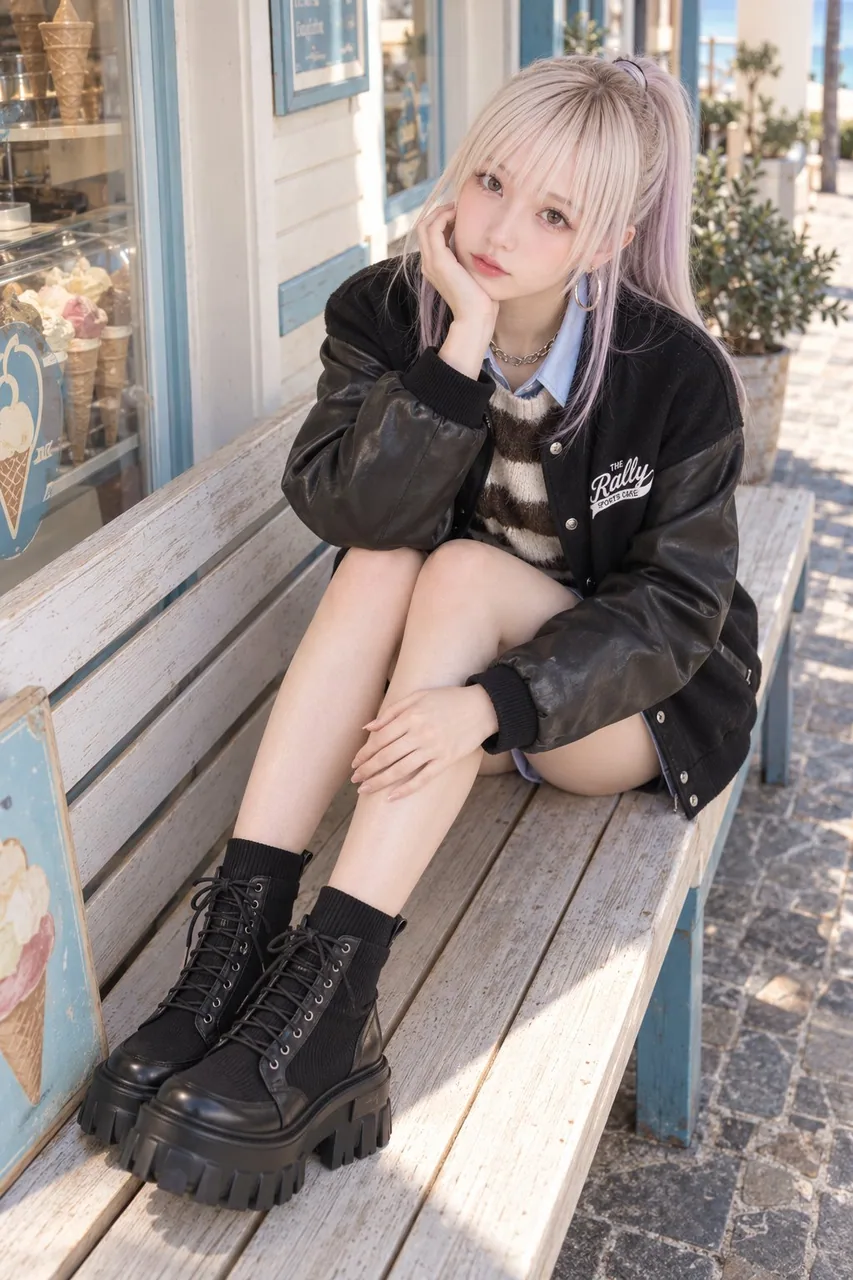
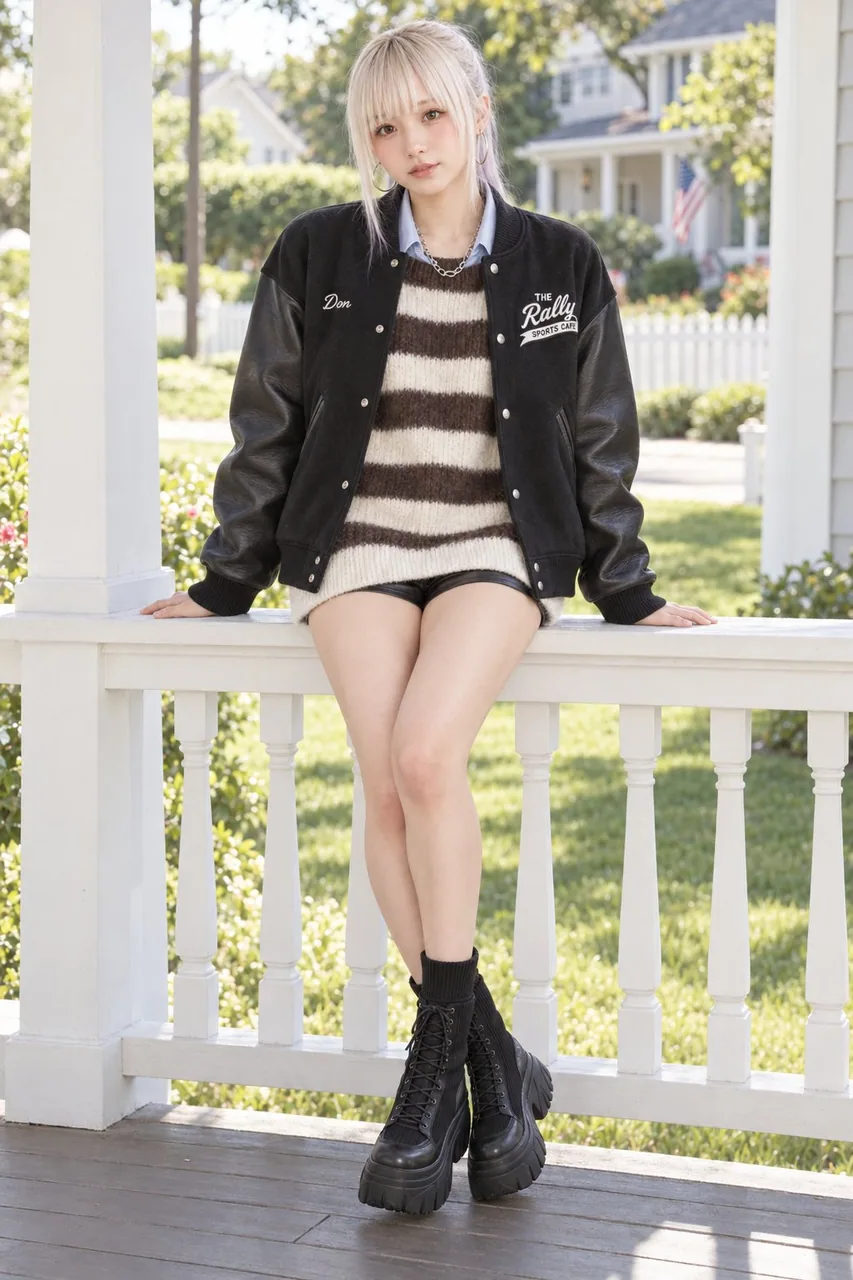
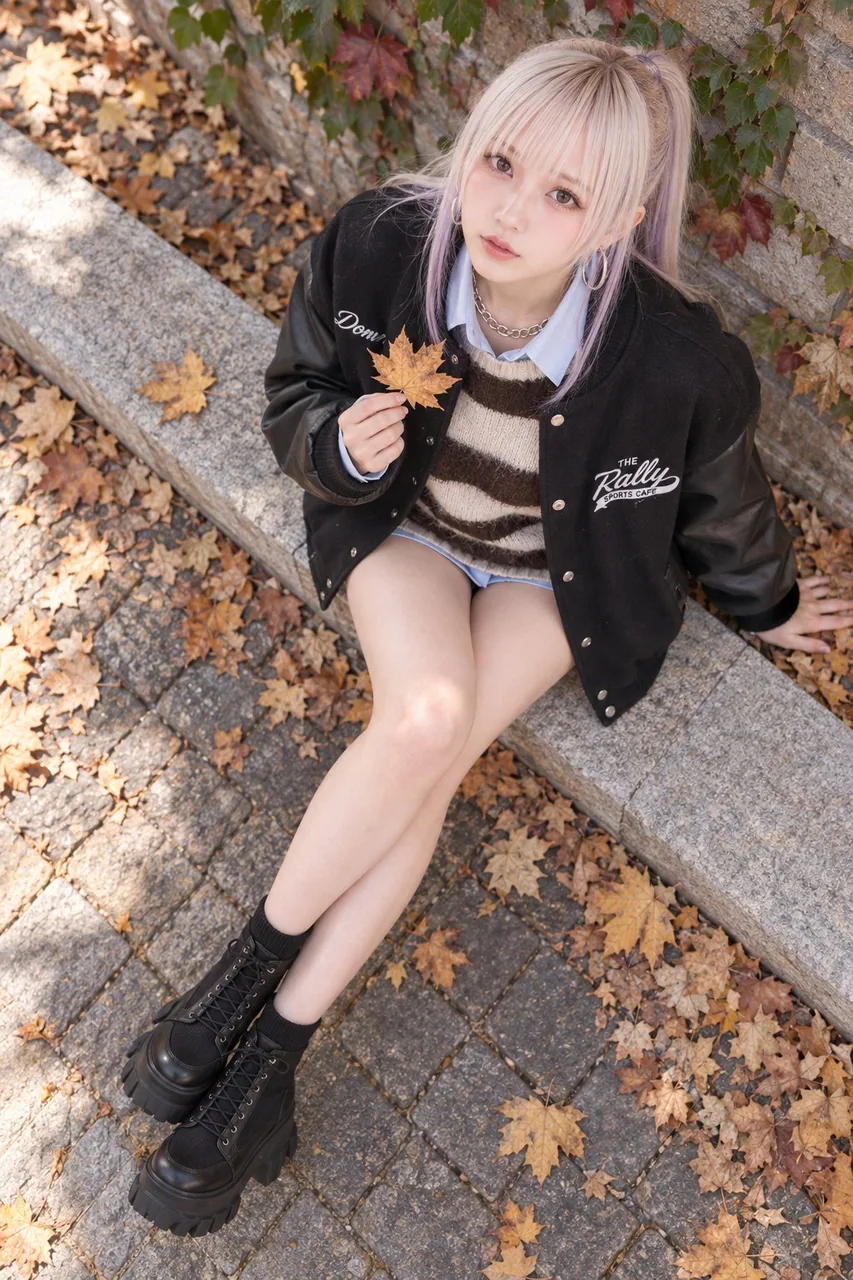
プロンプト
Photorealistic fashion portrait of a single adult woman, vertical 2:3, strongly person-dominant.

POSE AND LEG GEOMETRY:
Sit lengthwise on a deep storefront bench. Keep the pelvis toward frame-right and extend both lower legs forward along the seat toward frame-lower-left.
The knees stay close together and bent, but both ankles are placed well forward of the knees instead of tucked underneath them.
Keep the knees in front of the lap rather than pulled back against the chest.
Show long descending shin lines: each knee-to-ankle segment slopes approximately 25–35 degrees toward frame-left from image vertical.
Both feet rest fully on the bench top, with complete sole contact and visible seating surface beneath them. Keep the feet inside the seat perimeter rather than hanging over its front.
Preserve natural anatomy and the rounded knee bends; do not substitute completely straight legs.

ANATOMICAL LEFT/RIGHT LOCK:
Keep the anatomical left leg nearer the camera and on frame-right within the pair. Keep the anatomical right leg farther from the camera and on frame-left.
Both legs remain uncrossed. The left foot sits slightly farther forward, appearing slightly lower in the image.
Rest the anatomical right elbow on the right knee through a slight forward torso inclination. The right palm supports the right cheek.
Gently tilt the head toward anatomical right, with a calm direct gaze.
The anatomical left forearm drapes diagonally across the knees; the left hand rests along the anatomical right shin, fingers directed toward the right ankle.
Do not mirror, reverse, or exchange these relationships.

CAMERA AND COMPOSITION:
Full-frame camera with a 45mm rectilinear lens.
Camera height approximately 1.60 meters and horizontal distance approximately 1.90 meters from the hips.
Front-left-quarter viewpoint, approximately 35 degrees toward anatomical left from frontal. Photograph across the bench’s outer long side, not straight along the legs.
Downward pitch approximately 24 degrees; roll 0 degrees; optical axis near the waist.
Keep the bench running from lower-left foreground to upper-right background.
Include the full seated figure and both feet at approximately 86–90% of frame height.
Aperture f/5.6, shutter 1/320 sec, ISO 200. Focus on the eyes, with both lower-leg directions and sole-to-seat contacts clearly readable.

WARDROBE-VISIBILITY NON-OPTIMIZATION:
Do not modify knee bends, forward leg extension, foot contacts, arm positions, torso orientation, camera azimuth, height, pitch, focal length, crop, or scale to reveal clothing, footwear, accessories, graphics, or hardware. Preserve natural concealment and original detail placement. Do not rotate the feet for display. The setting must fit the pose.

BACKGROUND AND LIGHTING:
A seaside gelato-shop veranda with a deep wooden or painted bench, pale cream walls, airy coastal trim, a large shop window, and restrained glimpses of blue sky and greenery at the arcade edge. Keep the coastal setting secondary rather than opening into a landscape. Clean coastal daylight and soft sky fill illuminate the face. Background signs are fictional and unreadable.PROTECTED WARDROBE RULE — HIGHEST PRIORITY: Treat each garment description below as its immutable final product identity. Preserve construction, parts, hardware, material, pattern, and every registered graphic or marking—its surface, side, orientation, scale, colors, content, spelling, and count. FINAL WORN STATE overrides only the scoped item's use, position, side, orientation, fastening, layering, folds, tucks, knots, and drape. A SOURCE GARMENT label describes the unstyled item, never the completed silhouette. Do not redesign, add, remove, mirror, duplicate, relocate, or redraw protected details.

Wardrobe:

Hair — final selected state: HAIR GEOMETRY AUTHORITY — Every selected axis below replaces the source hair geometry only on that axis; retain source geometry only for axes explicitly set to Preserve.
TEXTURE CHECKSUM — Straight. Form continuous root-to-tip straight strands with natural body and no wave, curl, or coil pattern. At normal portrait scale, smooth straight strand direction with natural body must remain readable across multiple visible strand groups; one gravity or gathering arc is allowed, but repeating S-waves, ringlets, tight coils, and frizz are not. FRINGE — Keep the exact selected fringe visibly straight with natural body; do not add an S-wave, ringlet, or tight coil pattern to it; apply this to every selected-fringe strand without changing its roots, density, coverage, part, direction, route, or endpoint. MAIN HAIR — apply the same texture consistently to every declared visible hair-bearing cut-excluded section, the complete root-to-anchor scalp lead-in, and the arrangement's final visible tail, bun, twist, or other gathered mass. Texture changes strand path and surface relief only; keep the selected cut silhouette, fringe route, arrangement topology, and endpoints, create no hair merely to display texture, and never texture a shaved or scalp-close skin field. Reject a hybrid result in which only a terminal tail, bun, crest, panel edge, or endpoint carries the selected straight texture while another visible hair-bearing domain remains wavy, curly, coily, or frizzy. GATHERED LAYER CHECK — apply straight strand behavior through every scalp-following route, gathered section, braid, tail, bun, or twist surface; do not release reachable hair merely to display underlying layer endpoints.
CUT VISUAL TARGET — RELEASED SOURCE REFERENCE FOR FULL ARRANGEMENT — Medium layers: Length — collarbone perimeter; Front — shorter jaw-to-upper-neck layer endpoints; Side — intermediate shoulder-side endpoints; Rear — connected upper-neck-to-collarbone progression; Dominant perimeter weight — lower collarbone length remains visible; Layer topology — connected increasing layers with readable front, side and rear endpoints.
FULL ARRANGEMENT CUT VISIBILITY — The released cut geometry is not a competing final hairstyle. Hide every released endpoint belonging to arrangement-assigned hair inside the final gathered structure. Keep the exact selected fringe, selected face framing, every cut-specific arrangement-excluded zone, and every scalp-close or shaved field visible exactly as declared; never hide those retained zones merely because the arrangement mode is full.
ARRANGEMENT VISUAL TARGET — Mid ponytail: Final worn silhouette — exactly one full-volume tail emerging from one middle-occipital center-back anchor; Underlying cut priority — CUT VISUAL TARGET and Cut describe only the source strand lengths and layer topology when fully released before styling; this full arrangement controls the final visible silhouette, so no arrangement-assigned released endpoint may remain visible merely to display the cut, length, or texture; Arrangement mass priority — include every physically reachable arrangement-assigned strand in the declared structure; no reachable assigned hair may remain as an undeclared parallel loose mass; Loose-hair boundary — outside the final gathered structure permit only the exact selected fringe, the exact selected face-framing sections, only structural zones explicitly excluded by the cut-specific arrangement scope, only selected-cut layers genuinely unable to reach their required anchor or local braid pickup; Every exception must stay inside its declared rooted cut zone and must not recreate a duplicate loose version of arrangement-assigned hair, a parallel long curtain, or an undeclared second mass; Reject — a high top-knot, low nape anchor, second tail, loose underlayer, parallel rear curtain, or detached tail; Straight texture — permitted loose exceptions and gathered lead-ins remain straight, with no S-wave, curl, or rippled loose sheet.
Front sections: Fringe — Form a sparse airy fringe from fine separated strands across the forehead, keeping the eyebrows readable and avoiding one solid blunt edge. Keep all wispy strands on the forehead; none becomes a separate face-framing tendril. Face framing — Release exactly one narrow continuous section rooted at each temple and curve it beside the corresponding temple or cheek, ending no lower than the jaw within the selected haircut's available length; create no additional wisps. Keep every face-framing section outside the hair assigned to the Mid ponytail and independently rooted from its main routed structure. Root ownership — The fringe uses only the frontal hairline zone; selected face-framing uses one separate narrow temple-rooted band; all other roots remain in the main cut.
Preserve the natural hairline and exact source hair colors, including roots, highlights, lowlights, accents, and gradients; preserve all unselected hair attributes.
Cut: RELEASED SOURCE REFERENCE FOR FULL ARRANGEMENT — When released, form connected collarbone-length medium layers. Keep the longest lower perimeter at both collarbones; let shorter crown and upper-side layers end around the jaw and upper neck, then pass through intermediate shoulder-side and rear tips in one readable cascade into the collarbone edge. Preserve balanced crown lift, visible jaw-to-upper-neck and shoulder transitions, and a softly weighted collarbone perimeter in the front, sides, and rear. Do not flatten the cut into a one-length lob or turn it into a choppy shag, wolf cut, or pointed nape. Keep one naturally rooted haircut with no retained longer source underlayer, extension, wig edge, or duplicate hair mass.
Arrangement: Arrangement-assigned hair excludes the exact selected fringe and selected face-framing sections. For this varied-length cut, assign every arrangement-assigned strand within the geometry-declared source that can reach its corresponding declared hairstyle anchor from its own root; evaluate reachability to that anchor, not against the complete route or the final tail, braid, bun, or twist length. Keep only strands genuinely too short to reach their corresponding anchor at their selected rooted zones, without extending or reclassifying them; those exceptions must not recreate a duplicate loose version of arrangement-assigned hair, a parallel long curtain, or an undeclared second mass. Use all arrangement-assigned hair; draw both sides symmetrically backward along the scalp toward the middle occipital area. At the hairstyle anchor, use one center-back anchor halfway between the nape hairline and crown apex; let exactly one tail emerge continuously from that base. leave no other free side or back section; create no high top-knot, low nape anchor, second tail, loose underlayer, or detached tail. The route, anchor, result, free-section, and integrity clauses apply only to arrangement-assigned hair; keep every cut-excluded structural zone in the final haircut state declared above.
Measure the selected length on fully extended strands only to calculate underlying source mass and route reachability before gathering; do not compensate for wave, curl, or coil shrinkage when calculating that source mass; the full arrangement, not the released endpoints, controls the final visible silhouette.
Apply the selected texture within the declared arrangement; do not release gathered hair merely to display length or texture.

Outerwear / layers:

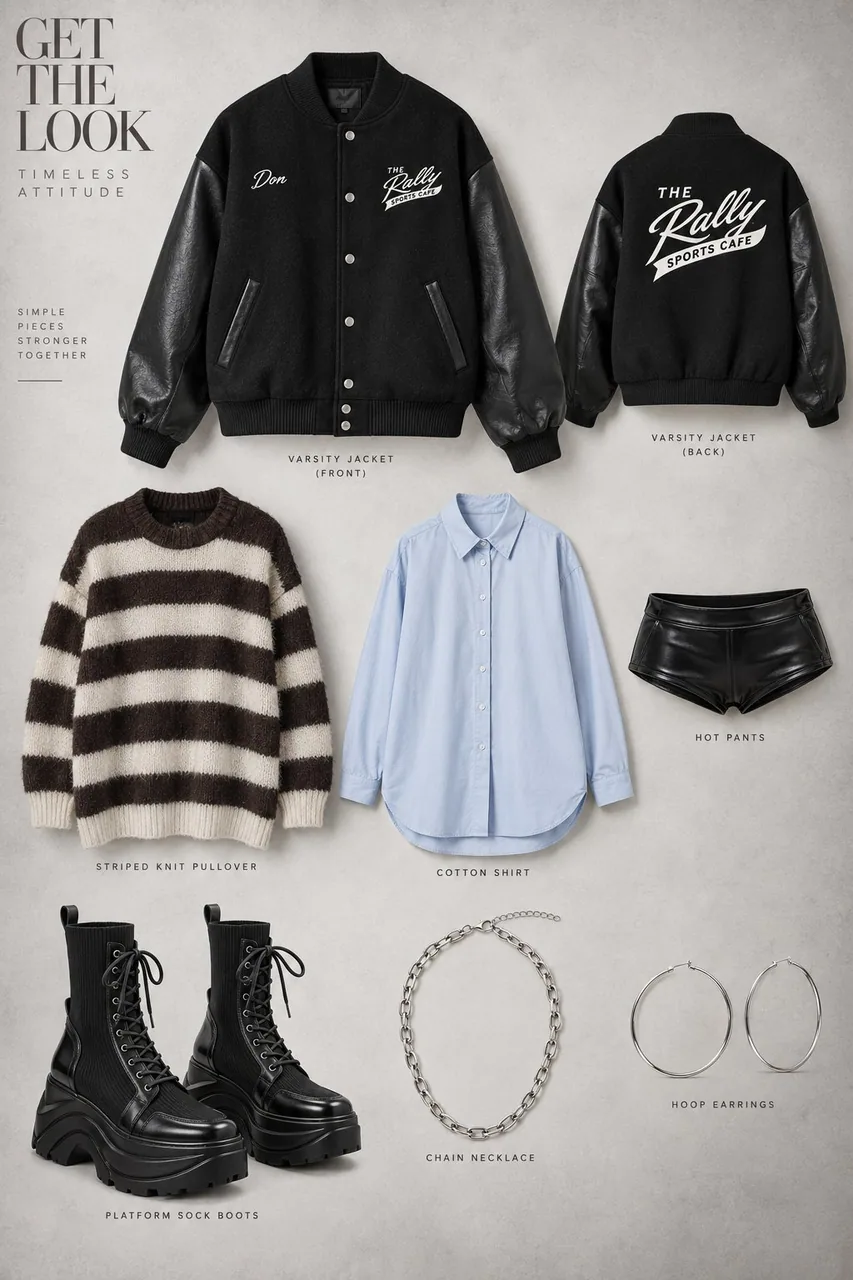
A relaxed hip-length black varsity jacket with a dense matte wool-blend body, dropped shoulders and full black leather sleeves with a supple, softly grained sheen. A low black rib-knit stand collar, ribbed cuffs and a broad ribbed waistband frame the boxy shape. Silver-tone snaps close the front, with a closely spaced lower pair at the waistband, and diagonal welt pockets sit at both sides. Small white cursive embroidery reading "Don" sits on the wearer's right chest. The left chest carries a compact white composition reading "THE" above "Rally" in flowing slanted script; the terminal stroke sweeps into a white underline ribbon containing black serif capitals reading "SPORTS CAFE", with a split pointed tail at the ribbon's left end. The same composition appears much larger across the upper back, surrounded by generous black space. Smooth black satin lining completes the interior.

Final worn state:
- Layering: Final state: keep this garment the complete outer layer over the second selected Top item; open only its original center-front fastening run within existing endpoints. Preserve source neckline, collar, front/rear panels, selected shoulder, sleeve, and body positions, plus fastening inventory, receiver mapping, order, spacing, endpoints, and placket length; add, remove, move, or extend nothing. FINAL FASTENING STATE: change only the source-registered primary closure mechanism inside its exact original endpoints. Preserve that mechanism, all original parts, its source length, and the garment construction beyond both endpoints; do not reinterpret a seam, fold, rib, placket, or panel edge as an extension, and add, duplicate, remove, or relocate nothing. Only layer order, contact, occlusion, and optical transmission change. Every visible garment boundary follows the outer item's source geometry or separately selected fold-return line; inner contours remain optically behind it. Keep panel contact shallow. Relaxed handling within this same operation: Use light stable contact and broader material-correct ease without changing the selected layer order.

Top:

An oversized long crew-neck pullover in thick, loosely knitted mohair-blend yarn with a soft shaggy halo and visible stockinette stitches. The straight relaxed body reaches the upper thighs, with dropped shoulders and roomy long sleeves. Ten broad horizontal bands alternate dark chocolate brown and ivory across the torso in approximately equal widths, starting with a brown band interrupted by the neckline and ending with ivory at the hem. The same stripe scale continues around the back and along the sleeves, with softly feathered color boundaries. A brown ribbed crew neck, ivory ribbed cuffs and a broad ivory ribbed hem finish the knit.

A relaxed long light-blue cotton-poplin shirt with a crisp pointed collar on a narrow stand and a full front placket of small pale buttons. The lightly structured woven fabric forms a roomy straight body, long sleeves with buttoned cuffs and a simple back yoke. Rounded shirttails reach the upper thighs, rising at the side seams, with the two front tails separating below the final button. The fabric is plain and smooth throughout.

Final worn state:
For the second item description above only:
- Front closure: Final state: within the original center-front fastening run, disconnect only its upper approximately one-third; keep every original below connected in place. Preserve the source count, type, order, spacing, endpoints, and placket length; never extend the run toward the hem or add, duplicate, remove, or relocate any fastening or receiver FINAL FASTENING STATE: every selected closed position is physically connected to its matching receiver; every selected open position is visibly disconnected, and panel overlap does not imitate a fastening. Preserve the source-defined fastening count, type, spacing, endpoints, and placket length; do not extend the fastening run or add, duplicate, remove, or relocate any fastening or receiver. Change only the selected registered state and leave every unselected component and connection unchanged.
- Layering: Final state: place this garment underneath the first selected Top item across the upper body. the first selected Top item remains the outer garment and retains and owns its exact source neckline aperture and edge, armholes, panel connectivity, closure state, straps, sleeves, and selected final hem or fold-return line. This inner garment contributes appearance only through the outer material's existing optical apertures; no inner contour becomes an outer boundary. Only layer order, contact, occlusion, and optical transmission change. Every visible garment boundary follows the outer item's source geometry or separately selected fold-return line; inner contours remain optically behind it. Keep panel contact shallow. Natural handling within this same operation: Use soft stable contact with limited material-correct ease.

Bottom: Low-rise, close-fitting black hot pants in glossy stretch faux leather, with a smooth contoured waistband, shaped front and back panels, a fitted crotch and very short legs. Narrow stitched hems curve upward at the outer hips and beneath the seat, while subtle seam lines shape the opaque body. A concealed side zipper closes the waistband, keeping the exterior clean and unembellished.

Footwear: A pair of black lace-up platform sock boots with close-fitting rib-knit shafts rising above the ankles and broad ribbed cuffs. The knit continues down the sides and across the vamp beneath smooth black leather-look toe surrounds, heel counters and curved lace facings. Round black laces cross through small loops over knitted tongues, and rear pull tabs assist entry. Rounded closed toes sit above extremely thick black molded soles with sweeping wave-like ridges, angular projecting side blocks, a recessed arch and deep segmented tread. Stretch collars, adjustable lacing and cushioned insoles complete the boots.

Necklace: A silver-tone necklace made from medium-sized rounded oval cable links with open centers and softly polished edges. The links alternate in angle to form a supple, moderately substantial chain that falls in a shallow U at the upper chest. A small rear lobster clasp and short matching extension complete the necklace, with no pendant.

Earrings: A pair of large silver-tone hoop earrings made from slender smooth round wire. The polished circular hoops have open centers and a light, undecorated profile, with small hinged posts closing discreetly at the earlobes.
日本語訳
大人の女性1人のフォトリアルなファッションポートレート。縦2:3、人物を強く主体とした構図。

ポーズと脚のジオメトリ:
店舗前の奥行きのあるベンチに、ベンチの長手方向に沿って座る。骨盤はフレーム右寄りに保ち、両方の下腿を座面に沿ってフレーム左下へ前方に伸ばす。
両膝は寄せて曲げたままにするが、両足首は膝の下に畳み込まず、膝より十分前方に置く。
膝は胸に引き寄せるのではなく、脚の付け根より前方に保つ。
長く下降する脛のラインを見せる。膝から足首までの各区間は、画像の垂直線からフレーム左方向へ約25–35度傾斜させる。
両足をベンチの座面に完全に載せ、靴底を全体で接触させ、足の下に座面が見えるようにする。足は座面の前端からはみ出させず、座面の範囲内に収める。
自然な解剖学的構造と丸みのある膝の曲がりを保持する。完全に真っ直ぐな脚に置き換えないこと。

解剖学的な左右のロック:
解剖学的に左の脚をカメラに近い側かつ2本のうちフレーム右側に保つ。解剖学的に右の脚をカメラから遠い側かつフレーム左側に保つ。
両脚は組まない。左足はわずかに前方に位置し、画像内ではわずかに低く見える。
上体をわずかに前傾させ、解剖学的に右の肘を右膝に載せる。右手のひらで右の頬を支える。
頭を解剖学的に右へ軽く傾け、穏やかにまっすぐ視線を向ける。
解剖学的に左の前腕を膝の上に斜めに掛ける。左手は解剖学的に右の脛に沿って置き、指は右の足首へ向ける。
これらの関係を鏡映しにしたり、反転したり、入れ替えたりしないこと。

カメラと構図:
フルサイズカメラ、45mmのレクティリニアレンズ。
カメラ高さは約1.60メートル、腰からの水平距離は約1.90メートル。
左前方4分の3の視点で、正面から解剖学的に左へ約35度。脚に沿って真っ直ぐではなく、ベンチの外側の長辺を横切るように撮影する。
下向きの俯角は約24度、ロールは0度、光軸は腰付近。
ベンチは左手前から右奥へ伸びるようにする。
着席した人物の全身と両足を、フレーム高さの約86–90%に収める。
絞り f/5.6、シャッター 1/320秒、ISO 200。目にピントを合わせ、両下腿の向きと靴底と座面の接触がはっきり読み取れるようにする。

衣装の見えやすさの非最適化:
衣服、履物、アクセサリー、グラフィック、金具を見せるために、膝の曲がり、脚の前方への伸長、足の接地、腕の位置、上体の向き、カメラの方位角、高さ、俯角、焦点距離、クロップ、スケールを変更しないこと。自然な隠れ方と元のディテール配置を保持する。足を見せるために回転させないこと。シチュエーションはポーズに合わせる。

背景とライティング:
海辺のジェラート店のベランダ。奥行きのある木製または塗装されたベンチ、淡いクリーム色の壁、風通しのよい海岸風の建具、大きな店の窓、そしてアーケードの端に控えめにのぞむ青空と緑。海岸のシチュエーションは二次的なものにとどめ、風景として開かないようにする。澄んだ海辺の日差しと柔らかなスカイフィルが顔を照らす。背景の看板は架空のもので、判読不能。PROTECTED WARDROBE RULE — 最優先: 以下の各衣服の記述を、変更不可の最終製品アイデンティティとして扱う。構造、パーツ、金具、素材、柄、および登録されたすべてのグラフィックやマーキングを保持する — その表面、側、向き、スケール、色、内容、綴り、数を含む。FINAL WORN STATE は、対象となるアイテムの用途、位置、側、向き、留め方、レイヤリング、折り目、タック、結び、ドレープのみを上書きする。SOURCE GARMENT というラベルはスタイリング前のアイテムを説明するものであり、完成したシルエットを説明するものではない。保護されたディテールを再設計、追加、削除、鏡映、複製、移動、描き直ししないこと。

衣装:

髪 — 最終選択状態: HAIR GEOMETRY AUTHORITY — 以下の選択された各軸は、その軸においてのみ元の髪形状を置き換える。元の形状は、Preserve と明示的に設定された軸についてのみ保持する。
TEXTURE CHECKSUM — ストレート。根元から毛先まで連続した直毛のストランドを、自然なボリュームで形成し、ウェーブ、カール、コイルのパターンを持たせない。通常のポートレートスケールで、自然なボリュームを持つ滑らかな直毛のストランド方向が、複数の可視ストランド群にわたって読み取れる必要がある。重力またはまとめによる弧が1つあるのは許容するが、繰り返すS字ウェーブ、リングレット、強いコイル、フリズは不可。FRINGE — 選択された正確な前髪を、自然なボリュームを持つ直毛として目視できる状態に保つ。S字ウェーブ、リングレット、強いコイルのパターンを加えないこと。これを選択された前髪のすべてのストランドに適用し、その根元、密度、被覆、分け目、方向、経路、終点を変えないこと。MAIN HAIR — 宣言された、毛髪を含む可視のカット除外セクションすべて、根元からアンカーまでの頭皮に沿った導入部全体、およびアレンジメントの最終的に見えるテール、シニヨン、ツイスト、その他のまとめた毛量に、同じテクスチャを一貫して適用する。テクスチャはストランドの経路と表面の起伏のみを変える。選択されたカットのシルエット、前髪の経路、アレンジメントのトポロジー、終点を保持し、テクスチャを見せるためだけに髪を作らず、剃った部分や頭皮に密着した肌の領域には決してテクスチャを施さない。末端のテール、シニヨン、クレスト、パネルの縁、または終点だけが選択された直毛テクスチャを持ち、他の可視の毛髪領域が波状、カール、コイル、フリズのままであるハイブリッドな結果は却下する。GATHERED LAYER CHECK — 頭皮に沿うすべての経路、まとめたセクション、編み込み、テール、シニヨン、ツイストの表面を通じて、直毛のストランド挙動を適用する。下層レイヤーの終点を見せるためだけに、到達可能な髪を解放しないこと。
CUT VISUAL TARGET — フルアレンジメントにおける解放状態の元リファレンス — ミディアムレイヤー: 長さ — 鎖骨周囲。前 — あごから首上部までの短いレイヤーの終点。側 — 肩の側面の中間の終点。後ろ — 首上部から鎖骨へつながる段階的な進行。支配的な周囲の重さ — 鎖骨下部の長さが見えたまま。レイヤーのトポロジー — 前・横・後ろの終点が読み取れる、つながった漸増レイヤー。
FULL ARRANGEMENT CUT VISIBILITY — 解放状態のカット形状は、競合する最終ヘアスタイルではない。アレンジメントに割り当てられた髪に属する解放された終点はすべて、最終的なまとめ構造の内側に隠す。選択された正確な前髪、選択された顔まわり、カット固有のアレンジメント除外ゾーンすべて、および頭皮に密着した部分や剃った部分すべてを、宣言どおりに見える状態に保つ。アレンジメントモードが full であるという理由だけで、これらの保持ゾーンを隠さないこと。
ARRANGEMENT VISUAL TARGET — ミディアムポニーテール: 最終着用シルエット — 後頭部中央の後ろ側アンカー1点から、フルボリュームのテールがちょうど1つ出る。下層カットの優先順位 — CUT VISUAL TARGET と Cut は、スタイリング前に完全に解放された状態の元のストランド長とレイヤートポロジーのみを記述する。このフルアレンジメントが最終的に見えるシルエットを制御するため、カット、長さ、テクスチャを見せるためだけに、アレンジメント割り当ての解放終点が見えたままになってはならない。アレンジメントの毛量の優先順位 — 物理的に到達可能なアレンジメント割り当てのストランドをすべて、宣言された構造に含める。到達可能な割り当て髪が、宣言されていない並行の遊離毛量として残ってはならない。遊離毛の境界 — 最終的なまとめ構造の外側では、選択された正確な前髪、選択された正確な顔まわりのセクション、カット固有のアレンジメント範囲で明示的に除外された構造ゾーンのみ、および必要なアンカーや局所的な編み込みの取り込みにどうしても到達できない選択カットのレイヤーのみを許可する。すべての例外は、宣言された根元のカットゾーンの内側にとどまり、アレンジメント割り当て髪の重複した遊離版、並行する長いカーテン、宣言されていない第2の毛量を再現してはならない。却下 — 高いトップノット、低い後ろ首のアンカー、第2のテール、遊離した下層、並行する後ろのカーテン、切り離されたテール。直毛テクスチャ — 許可された遊離の例外とまとめの導入部は直毛のままとし、S字ウェーブ、カール、波打つ遊離の面を生じさせない。
フロントセクション: 前髪 — 額全体に、細く分離したストランドでまばらで軽やかな前髪を作り、眉が読み取れるようにし、一枚板のような一直線の切り揃えを避ける。細い毛はすべて額の上にとどめ、どれも独立した顔まわりの後れ毛にしない。顔まわり — 左右のこめかみそれぞれを根元とする、狭く連続したセクションをちょうど1つ解放し、対応するこめかみまたは頬の横でカーブさせ、選択されたヘアカットで利用可能な長さの範囲内で、あごより下では終わらせない。追加の後れ毛を作らないこと。すべての顔まわりのセクションを、ミディアムポニーテールに割り当てられた髪の外側に保ち、その主たるルーティング構造とは独立した根元にする。根元の帰属 — 前髪はフロントの生え際ゾーンのみを使う。選択された顔まわりは、こめかみを根元とする別の細い帯を1つ使う。その他の根元はすべてメインのカットに残る。
自然な生え際と、元の正確な髪色(根元、ハイライト、ローライト、アクセント、グラデーションを含む)を保持する。選択されていない髪の属性をすべて保持する。
カット (Cut): フルアレンジメントにおける解放状態の元リファレンス — 解放したときは、つながった鎖骨丈のミディアムレイヤーを形成する。最も長い下部の周囲を両方の鎖骨に保つ。短い頭頂部と上部側面のレイヤーは、あごと首上部あたりで終わらせ、その後、中間の肩側面と後ろの毛先を通って、読み取れる1つのカスケードとして鎖骨の縁へ流す。バランスの取れた頭頂部の持ち上がり、読み取れるあごから首上部、肩への移行、そして前・横・後ろの柔らかく重みのある鎖骨周囲を保持する。カットをワンレングスのロブに平坦化したり、ぎざぎざのシャグ、ウルフカット、とがった後ろ首に変えたりしないこと。自然な根元を持つ1つのヘアカットを保ち、長い元の下層、エクステンション、ウィッグの縁、重複した毛量を残さない。
アレンジメント: アレンジメントに割り当てられる髪は、選択された正確な前髪と選択された顔まわりのセクションを除外する。この長さの異なるカットでは、形状で宣言された元の中で、自身の根元から対応する宣言済みのヘアスタイルアンカーに到達できるすべてのアレンジメント割り当てストランドを割り当てる。到達可能性はそのアンカーに対して評価し、完全な経路や最終的なテール、編み込み、シニヨン、ツイストの長さに対して評価しない。選択された根元ゾーンにおいて、対応するアンカーにどうしても到達できないほど短いストランドのみを残し、それらを延長したり再分類したりしない。これらの例外は、アレンジメント割り当て髪の重複した遊離版、並行する長いカーテン、宣言されていない第2の毛量を再現してはならない。アレンジメント割り当て髪をすべて使う。両側を頭皮に沿って中央後頭部へ対称的に後ろへ引く。ヘアスタイルアンカーには、後ろ首の生え際と頭頂部の中間にある後ろ中央のアンカーを1つ使う。その基部から連続してテールがちょうど1つ出るようにする。他の自由な側面や後ろのセクションを残さない。高いトップノット、低い後ろ首のアンカー、第2のテール、遊離した下層、切り離されたテールを作らないこと。経路、アンカー、結果、自由セクション、完全性の条項は、アレンジメント割り当て髪にのみ適用される。カットで除外された構造ゾーンはすべて、上で宣言された最終ヘアカット状態に保つ。
選択された長さは、まとめる前に下層の元の毛量と経路の到達可能性を計算するためにのみ、完全に伸ばしたストランドで測定する。その元の毛量を計算する際、ウェーブ、カール、コイルの収縮を補正しないこと。最終的に見えるシルエットを制御するのは、解放された終点ではなくフルアレンジメントである。
選択されたテクスチャは、宣言されたアレンジメントの範囲内で適用する。長さやテクスチャを見せるためだけに、まとめた髪を解放しないこと。

アウター/レイヤー:

リラックスしたヒップ丈の黒いバーシティジャケット。密度の高いマットなウール混紡の身頃、ドロップショルダー、そして柔らかくきめ細かな光沢を持つ総黒レザーの袖。低めの黒いリブニットのスタンドカラー、リブの袖口、幅広のリブのウエストバンドがボクシーな形を縁取る。シルバートーンのスナップで前を留め、ウエストバンドには間隔の狭い下側の一対があり、両側に斜めのウェルトポケット。着用者の右胸に "Don" と読める小さな白い筆記体の刺繍。左胸には、"THE" の下に流れるような斜体スクリプトで "Rally" と読めるコンパクトな白いコンポジション。終端のストロークは白い下線リボンへと流れ、その中に黒いセリフ体の大文字で "SPORTS CAFE" と読み取れ、リボンの左端には割れた先端のテールがある。同じコンポジションが上背部にずっと大きく現れ、ゆとりある黒い空間に囲まれている。滑らかな黒いサテンの裏地が内側を完成させる。

最終着用状態:
- レイヤリング: 最終状態: この衣服を、選択された2番目の Top アイテムの上に重ねる完全なアウター層として保つ。元の前中心の留め具列を、既存の端点の範囲内でのみ開く。元のネックライン、カラー、前後のパネル、選択された肩、袖、身頃の位置、および留め具の構成、受け側の対応、順序、間隔、端点、前立ての長さを保持する。何も追加、削除、移動、延長しないこと。FINAL FASTENING STATE: 元に登録された主たる閉じ機構を、その正確な元の端点の内側でのみ変更する。その機構、すべての元のパーツ、その元の長さ、および両端点より先の衣服の構造を保持する。縫い目、折り目、リブ、前立て、パネルの縁を延長として再解釈せず、何も追加、複製、削除、移動しないこと。変わるのはレイヤーの順序、接触、遮蔽、光学的な透過のみ。見える衣服の境界はすべて、外側アイテムの元の形状または別途選択された折り返し線に従う。内側の輪郭はその光学的に背後に留まる。パネルの接触は浅く保つ。この同じ操作の範囲内でのリラックスした扱い: 選択されたレイヤー順序を変えずに、軽く安定した接触と、素材に合ったより広いゆとりを使う。

トップス:

厚手で粗く編まれたモヘア混紡糸のオーバーサイズの長いクルーネックプルオーバー。柔らかく毛羽立つハローと、目に見えるメリヤス編みの目。まっすぐでゆとりある身頃は太もも上部まで届き、ドロップショルダーとゆったりした長袖。胴部には幅広の横縞が10本、ダークチョコレートブラウンとアイボリーがほぼ等幅で交互に並び、ネックラインで途切れるブラウンの縞から始まり、裾ではアイボリーで終わる。同じ縞のスケールが背中と袖にも続き、色の境界は柔らかくフェザリングしている。ブラウンのリブのクルーネック、アイボリーのリブの袖口、幅広のアイボリーのリブの裾がニットを仕上げる。

リラックスした長いライトブルーのコットンポプリンシャツ。細い台襟にパリッとしたポイントカラー、そして淡い色の小さなボタンが並ぶ完全な前立て。軽く張りのある織物が、ゆとりあるまっすぐな身頃、ボタン付きカフスの長袖、シンプルな後ろヨークを形作る。丸みのあるシャツテールは太もも上部まで届き、脇の縫い目で上がり、前の2つの裾は最後のボタンの下で分かれる。生地は全体に無地で滑らか。

最終着用状態:
上記の2番目のアイテムの記述についてのみ:
- 前留め: 最終状態: 元の前中心の留め具列のうち、上側の約3分の1のみを外す。それより下の元の留め具はすべて接続したままの位置に保つ。元の数、種類、順序、間隔、端点、前立ての長さを保持する。留め具列を裾に向かって延長したり、留め具や受け側を追加、複製、削除、移動したりしないこと。FINAL FASTENING STATE: 選択された閉じ位置はすべて、対応する受け側に物理的に接続されている。選択された開き位置はすべて視覚的に切り離されており、パネルの重なりが留め具を模倣しない。元で定義された留め具の数、種類、間隔、端点、前立ての長さを保持する。留め具列を延長したり、留め具や受け側を追加、複製、削除、移動したりしないこと。選択された登録状態のみを変更し、選択されていない構成要素と接続はすべて変更しない。
- レイヤリング: 最終状態: この衣服を、上半身において選択された1番目の Top アイテムの下に置く。1番目の Top アイテムはアウターとして残り、その正確な元のネックライン開口部と縁、アームホール、パネルの連結、閉じ状態、ストラップ、袖、および選択された最終的な裾または折り返し線を保持し所有する。この内側の衣服は、外側の素材が既に持つ光学的な開口部を通してのみ外観に寄与する。内側の輪郭が外側の境界になることはない。変わるのはレイヤーの順序、接触、遮蔽、光学的な透過のみ。見える衣服の境界はすべて、外側アイテムの元の形状または別途選択された折り返し線に従う。内側の輪郭はその光学的に背後に留まる。パネルの接触は浅く保つ。この同じ操作の範囲内での自然な扱い: 素材に合った限られたゆとりで、柔らかく安定した接触を使う。

ボトムス: ローライズで体に密着した黒いホットパンツ。光沢のあるストレッチのフェイクレザー製で、滑らかで立体感のあるウエストバンド、形作られた前後のパネル、フィットした股ぐり、ごく短い脚。細いステッチの裾は外側のヒップと座面の下で上向きにカーブし、繊細な縫い目のラインが不透明な身頃を形作る。隠しサイドファスナーがウエストバンドを閉じ、外観をクリーンで装飾のないものに保つ。

履物: 黒いレースアップのプラットフォームソックブーツ一足。足首より上まで伸びる体に密着したリブニットのシャフトと、幅広のリブのカフ。ニットは側面を下り、滑らかな黒いレザー調のトゥ周り、ヒールカウンター、湾曲したレースフェーシングの下の甲まで続く。丸い黒いレースがニットのタンの上で小さなループに交差し、後ろのプルタブが履き入れを助ける。丸みのある閉じたトゥは、非常に厚い黒い成型ソールの上に位置し、そのソールには大きく波打つような畝、角ばって張り出したサイドブロック、くぼんだアーチ、深い分割トレッドがある。ストレッチカラー、調節可能なレース、クッション性のあるインソールがブーツを完成させる。

ネックレス: シルバートーンのネックレス。中サイズの丸みのある楕円形のケーブルリンクを使い、中心は空洞で縁は柔らかく磨かれている。リンクは角度を交互に変えて、しなやかでほどよい存在感のチェーンを形成し、胸上部で浅いU字を描いて落ちる。小さな後ろのロブスタークラスプと短い共布の延長チェーンがネックレスを完成させ、ペンダントはない。

イヤリング: 大きなシルバートーンのフープイヤリング一対。細く滑らかな丸線で作られている。磨かれた円形のフープは中心が空洞で、軽く装飾のないプロファイルを持ち、小さなヒンジ式のポストが耳たぶで目立たずに留まる。
出典
- 原作者
- MoodLock_JP
- 公開日
- 2026-09-10
- 原典
- 元の投稿を見る ↗
- 収録元
- xianyu110/awesome-gpt-image2.5 · 2097937963523145829 · MIT