Use @[storyboard ref]  as the authoritative director-approved storyboard blueprint for the sequence. Treat every storyboard panel as a consecutive shot within a single cinematic sequence. Follow panel order exactly and do not invent alternative coverage. Do not render the storyboard sheet itself. Preserve camera placement, framing, lens intent, shot scale, character staging, screen direction, environmental geography, prop placement, action choreography, continuity and emotional escalation shown by the storyboard. The storyboard is the primary source of truth for visual storytelling. Recreate the filmed sequence implied by the panels rather than the physical storyboard artwork.
The entire video must play as one continuous developing master shot with no visible cuts; each panel is a sampled phase of the same uninterrupted camera move, not a separate shot.
Use one virtual lens / same-lens move; angle changes come from backward front-track, push-in, shallow front-side orbit, and pullback only. Never pass behind Rand.
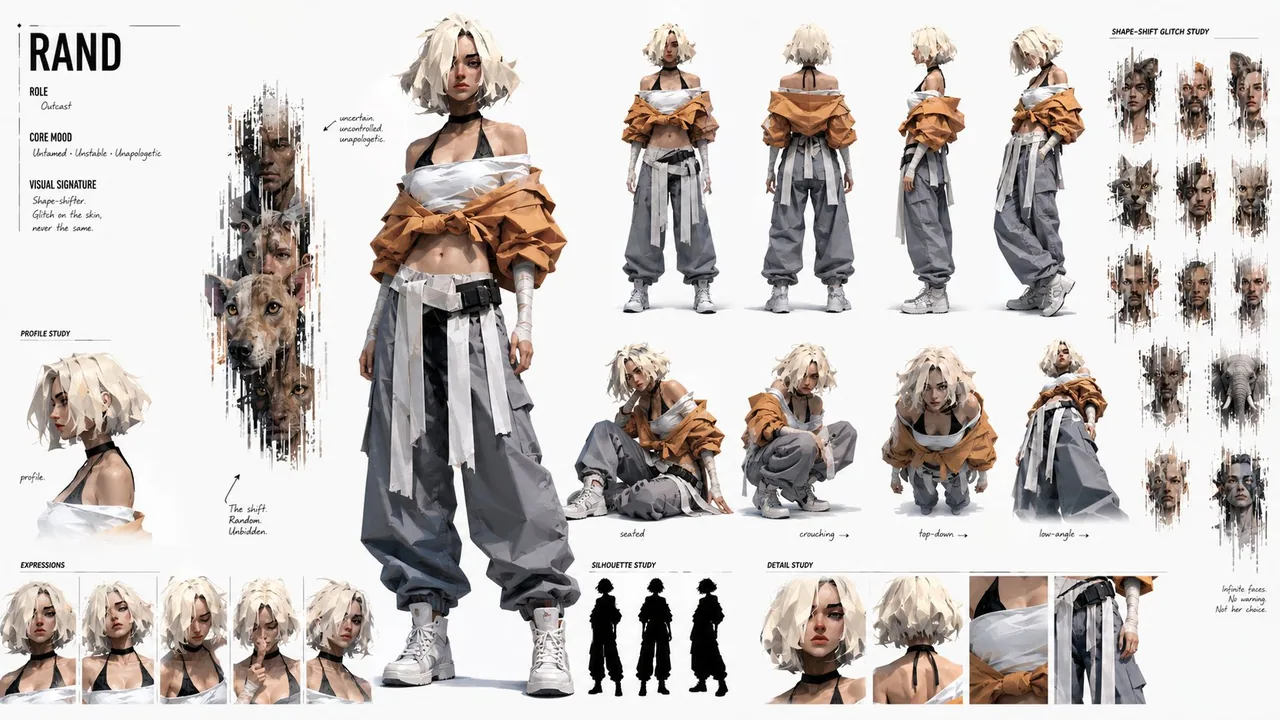
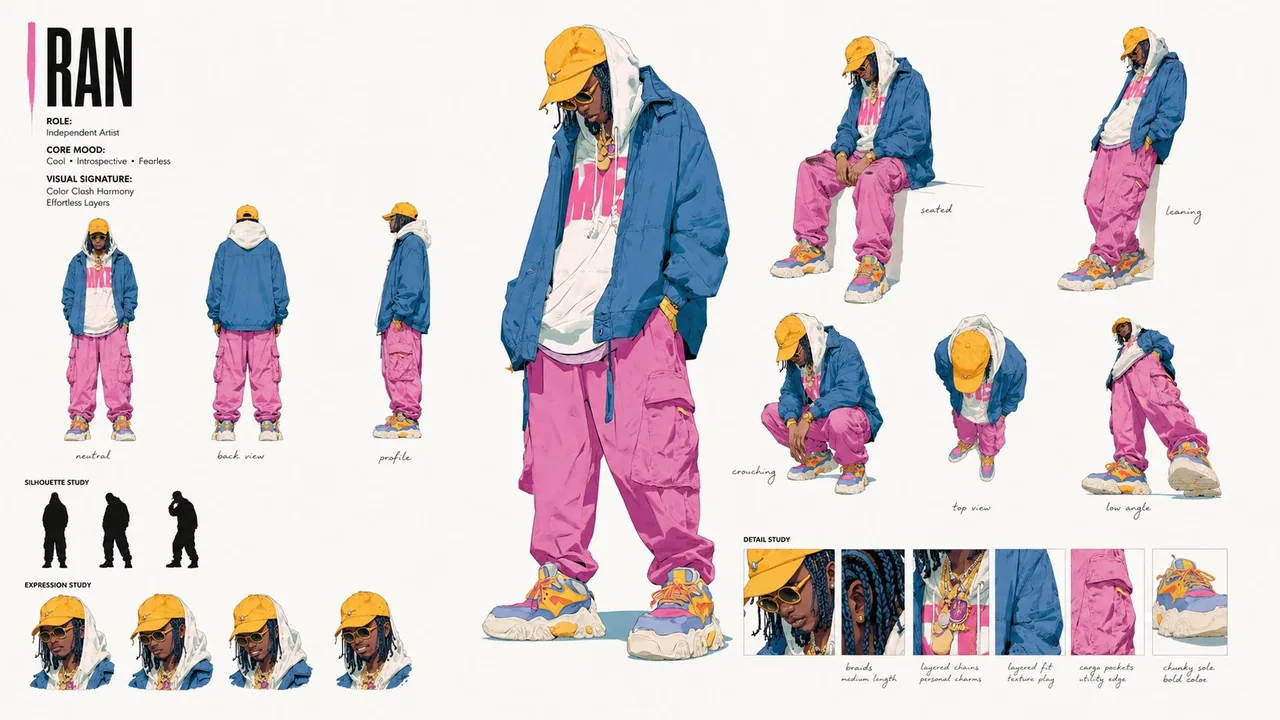
Use @[char1 ref] as starting Rand/C1. Use @[char2 ref]  as final RAN.

ENVIRONMENT: Vivid daytime street into quiet passage: colorful storefront glass, crosswalk, posters, bollards, hard shadows, unaware crowd, right-side escape. Rand runs toward the camera as it retreats in front of her.
EMOTIONAL GUIDANCE: Valence: vulnerable public appeal into private panic, then altered control. Arousal: urgent run -> "I can't control this" flicker -> false heads -> palm-slap snapbacks -> hidden roulette -> RAN lock. Crowd never notices.
VISUAL STYLE: Match @[char1 ref] : faceted semi-real concept art, vivid daylight, crisp skin, polygon texture, hard shadows, vertical black-gray pixels stuck to Rand's whole head until final body lock; no side faces.
TRANSFORMATION RULE: P03-P07 must not show face fragments beside Rand or as floating panels. Each temporary identity replaces the actual head attached to Rand's neck for a readable instant, like a broken TV channel. Body keeps running/bracing while the head swaps. Original Rand head returns only after each open-palm slap. Only final @[char1 ref] lock spreads below the neck.
AUDIO: No music. Use crowd, footsteps, breath, clothing rustle, pixel tearing, palm-head slaps, glitch snaps, dialogue.

PANEL BEATS:
P01: Wide backward front-track. Rand runs toward camera through unaware crowd, original identity intact, colorful storefronts behind her.
P02: Camera retreats in front of her as she looks into the lens, breathing hard: "You're probably wondering why I'm running."
P03: Camera keeps retreating front-side as she spots the passage: "I need to get away before it starts. I can't control this." On that line, she looks to lens; her whole head starts vertical glitching, still attached to her neck.
P04: Camera pushes closer. Three human heads replace her actual head one after another, each in the same skull position, never beside it. She open-palm slaps side of head like fixing a TV, no pointing; original Rand head snaps back.
P05: More whole-head swaps cycle on the neck: older man, pale mask-like face, shaved head, then a clear animal head as rejected option. Rand gives another open-palm slap; Rand head briefly returns.
P06: Camera backs into passage with her as she ducks into cover; first dense whole-head roulette shows readable heads replacing her actual head in micro-freezes, body/clothes still Rand's.
P07: Still front-side in cover, second roulette beat shows different readable heads replacing the same head volume; no side faces, no floating panels, no clones, no detached masks.
P08: At the wall, closest front-side orbit: roulette stops on @[char2 ref] RAN. Only now the glitch runs down the body as cap, braids, sunglasses, blue jacket, hoodie, pink cargos, chains, sneakers lock in.
P09: Camera pulls wider in passage. RAN lowers his hand, fully changed into @[char2 ref], looks to lens, says, "See? I told you. I can't control it."

---

I shared the storyboard skill file I use for these prompts with my subscribers.
中文译文
将 @[storyboard ref]  作为该段落经导演认可的权威故事板蓝图。把每一格故事板都视为单一电影化段落中的连续镜头。严格遵循分格顺序,不得虚构替代性的镜头覆盖方案。不要渲染故事板图纸本身。保留故事板所呈现的机位、取景构图、镜头意图、景别、角色走位、银幕方向、环境地理关系、道具位置、动作编排、连续性与情绪递进。故事板是视觉叙事的首要事实来源。要重建这些分格所暗示的实拍序列,而不是故事板的实体画面。
整段视频必须呈现为一个持续发展的连续长镜头,没有可见的剪辑;每一格分镜都是同一次不间断运镜中被采样到的一个阶段,而不是一个单独的镜头。
使用同一支虚拟镜头 / 同镜头运动;角度变化只能来自后退式前跟、推进、浅幅前侧环绕和拉回。绝不从 Rand 身后经过。
使用 @[char1 ref] 作为起始的 Rand/C1。使用 @[char2 ref]  作为最终的 RAN。

环境:鲜明的日间街道转入安静的通道:色彩缤纷的店面玻璃、人行横道、海报、护柱、硬阴影、毫无察觉的人群、右侧的逃生路线。Rand 朝着镜头奔跑,而镜头在她前方后退。
情绪指导:效价:从脆弱的当众诉求转入私下的恐慌,再转入被改变的控制感。唤醒度:急切的奔跑 -> "I can't control this" 的闪烁 -> 假头部 -> 掌掴回弹 -> 隐藏的轮盘 -> RAN 锁定。人群始终没有察觉。
视觉风格:匹配 @[char1 ref] :多切面半写实概念艺术、鲜明的日光、清晰的皮肤、多边形质感、硬阴影、竖条状黑灰色像素附着在 Rand 的整个头部,直到最终的身体锁定;不出现侧脸。
变形规则:P03-P07 不得在 Rand 身旁显示脸部碎片,也不得将其作为悬浮面板呈现。每一个临时身份都会在一个可读的瞬间替换连接在 Rand 脖子上的真实头部,如同一个故障的电视频道。头部替换时,身体仍在奔跑/支撑。只有在每一次张开手掌的拍击之后,Rand 原本的头部才会回归。只有当最终的 @[char1 ref] 锁定后,变化才蔓延到脖子以下。
音频:无音乐。使用人群声、脚步声、呼吸声、衣物摩擦声、像素撕裂声、手掌拍头声、故障脆响、对白。

分镜节拍:
P01:广角后退式前跟。Rand 穿过毫无察觉的人群朝镜头奔跑,原本的身份完好无损,她身后是色彩缤纷的店面。
P02:镜头在她前方后退,她看向镜头,呼吸急促:"You're probably wondering why I'm running."
P03:镜头继续在前侧后退,她发现了那条通道:"I need to get away before it starts. I can't control this." 说到这句时,她看向镜头;她的整个头部开始竖向故障闪烁,但仍连在她的脖子上。
P04:镜头推进。三颗人类头部依次替换她的真实头部,每一颗都处在同一个头骨位置,绝不位于其旁边。她张开手掌拍打头侧,像在修理电视机,不得出现用手指指点的动作;Rand 原本的头部随即弹回。
P05:更多整体头部的替换在脖子上循环:年长男性、苍白面具般的脸、剃光的头,然后是一颗清晰的动物头作为被否定的选项。Rand 再次张开手掌拍击;Rand 的头部短暂回归。
P06:镜头随她后退进入通道,她闪身躲进掩体;第一次密集的整体头部轮盘以微冻结的方式展示可辨识的头部替换她的真实头部,身体/衣服仍然是 Rand 的。
P07:仍在掩体中的前侧机位,第二次轮盘节拍展示不同的可辨识头部替换同一个头部体量;不出现侧脸、不出现悬浮面板、不出现克隆体、不出现分离的面具。
P08:在墙边,最近距离的前侧环绕:轮盘停在 @[char2 ref] RAN 上。直到此时,故障才沿身体向下蔓延,帽子、辫子、太阳镜、蓝色夹克、连帽衫、粉色工装裤、链条、运动鞋随之锁定。
P09:镜头在通道中拉得更宽。RAN 放下手,完全变成 @[char2 ref],看向镜头,说道:"See? I told you. I can't control it."

---

我把我在这些提示词中使用的故事板技能文件分享给了我的订阅者。