巨桶城市海报:尺度幻觉靠微型街区钉死
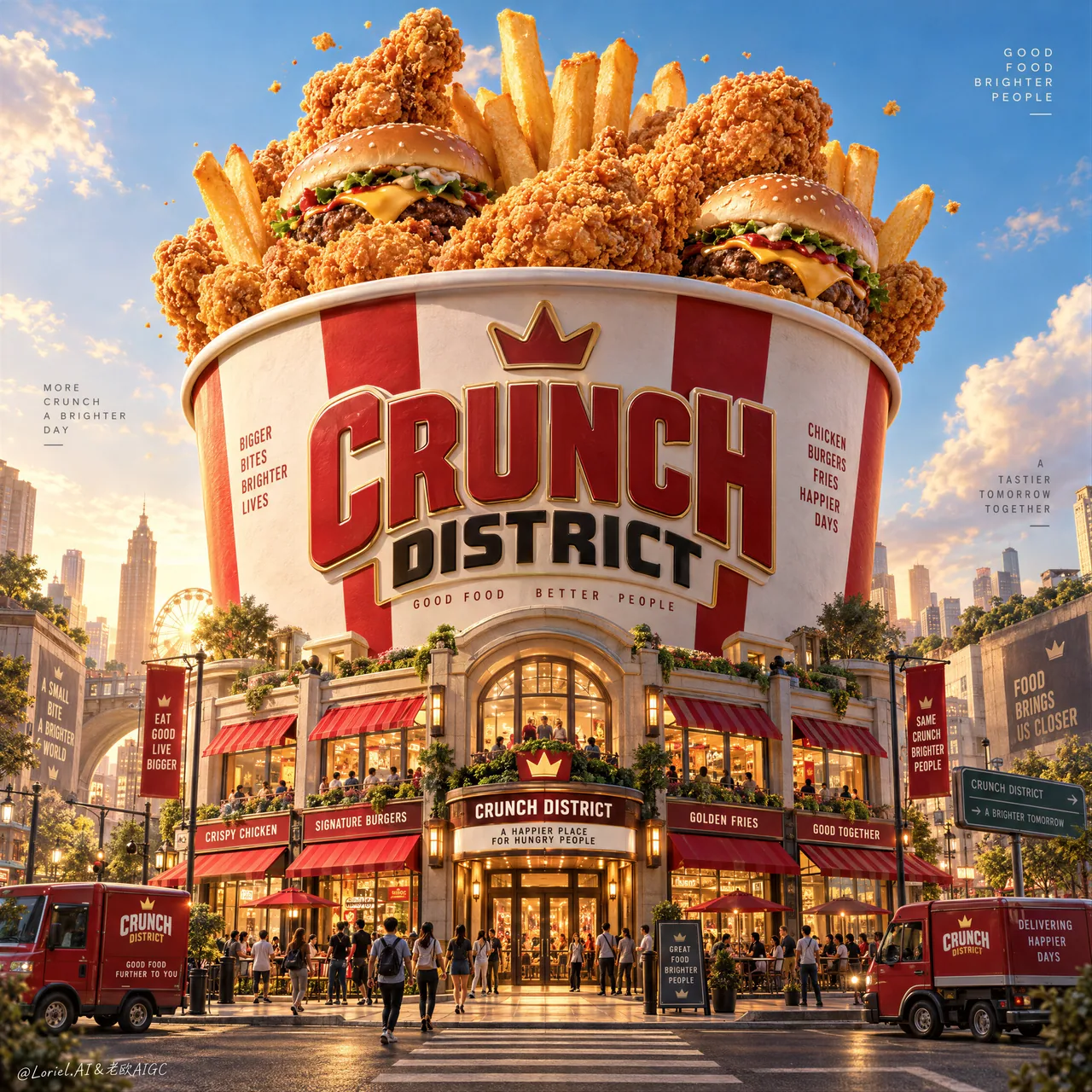
街角仰拍巨型炸鸡桶,底座长出迷你店面区。用建筑给产品量尺度的快餐 KV 教科书。
提示词
Create a Cannes-level ultra-premium fast-food advertising poster for a fictional brand called CRUNCH DISTRICT, preserving the exact structural logic of a monumental bucket-city campaign while merging narrative spectacle, forensic food realism, and curatorial restraint into one resolved image. The composition is vertical and cinematic: one colossal fried-chicken bucket rises in the center like an urban landmark, overflowing with hero fast-food items, while its lower structure transforms into a compact branded street district with storefronts, awnings, food kiosks, tiny pedestrians, and a few parked delivery vehicles. The image must feel like an entire city built around appetite, yet remain clean, disciplined, and unmistakably product-led.

Core composition: use a low street-level perspective looking slightly upward so the bucket dominates the skyline from lower frame to upper-middle frame. The giant bucket must be perfectly centered and visually stable, with premium dimensional branding integrated on the front as the main architectural identity mark, such as “CRUNCH DISTRICT”. From the bucket opening, let oversized fried chicken pieces, upright fries, and a small number of burgers emerge like a celebratory edible skyline. Keep the upper sky open and breathable, with only a few sculptural cloud forms and a sparse scattering of tiny crumbs or coating particles. The bucket remains the unquestioned hero; the surrounding city only reinforces its myth.

Orbit atmosphere: the poster should feel like a legendary fast-food district at the height of its golden-hour energy, as if the city has gathered around a sacred monument of crunch. The streets below suggest excitement, gathering, and ritual, but not chaos. Tiny figures, storefront lights, and food trucks create the emotional impression of a living destination, while the oversized foods above feel like a dream of abundance made real. The tone should be joyful, larger-than-life, and cinematic, yet mature enough to feel like an international award-winning campaign rather than a theme-park illustration.

Transit realism: render every food and architectural surface with commercial-grade precision. The fried chicken must show layered craggy crust, realistic breading granules, warm oil-sheen glints, crackled edges, and dense golden-orange browning with deeper amber shadows in the creases. The fries should stand upright with believable rigidity, lightly salted surfaces, faint blistering, and clear potato structure. The burgers should show soft glossy buns, seared patties, clean cheese melt, and minimal but readable fillings. The bucket itself must feel like premium printed packaging at enormous scale, with crisp label edges, subtle paperboard texture, smooth curvature, and believable structural volume. The street-level district must carry refined storefront materials, striped awnings, glass reflections, painted trims, asphalt texture, signage relief, and small vehicle detail that all feel physically grounded.

Port restraint: simplify the visual system so the grandeur feels curated rather than overloaded. Keep only the giant bucket, a select number of floating hero foods, a handful of cloud shapes, a compact but rich architectural base, and a few sparse atmospheric crumbs. Reduce excessive signage, over-busy urban clutter, and random decorative elements. Let the contrast between monumental object and miniature city create the intelligence of the composition. The poster should feel more like a luxury exhibition image for fast food culture than a noisy retail ad.

Street-district design: build the base of the bucket into an elegant branded neighborhood with 4–6 visible storefront fronts, a central entrance, a few lit windows, one or two delivery vans, and a controlled number of tiny pedestrians interacting naturally in the street. Include a crosswalk or narrow roadway in the foreground to ground the viewer in the city scale. The small architecture should feel lively and precise, but still secondary to the giant bucket and hero foods above.

Lighting: use high-end warm daylight with slight golden-hour character. The upper food elements catch the brightest sunlight, creating premium highlights on chicken crust, fry edges, and burger buns. The bucket surface should carry soft sculptural shading and subtle frontal readability. At street level, introduce slightly warmer reflected light and refined storefront glows to deepen the sense of place. Keep shadows rich but never muddy, and avoid dead black areas.

Material and texture: emphasize crunchy crust topography, fry salt crystals, burger bun gloss, soft paperboard bucket finish, sign lettering depth, glass storefront reflections, painted architectural trims, tiny street objects, and subtle atmospheric dust. Every material must feel photographically plausible and luxuriously retouched.

Color hierarchy: 60% fried-gold, creamy bucket white, and luminous sky blue; 30% ketchup red, warm caramel browns, and urban neutral shadows; 10% green, teal, and sign-light accents in tiny controlled touches. The palette must feel appetizing, festive, and internationally premium.

Design intent: the final poster must preserve the exact impact logic of a giant central bucket monument, overflowing hero food, a miniature branded city at its base, and a clean sky-framed vertical composition, while merging Orbit atmosphere, Transit realism, and Port curatorial restraint into one complete fast-food myth image. The bucket is the city, the city is the brand, and the brand is the appetite.

Rendering style: ultra-photoreal luxury fast-food advertising, cinematic branded food-world architecture, premium packaging monument, highly detailed miniature urban district, world-class commercial retouching, clean graphic hierarchy, appetizing hero-food realism, print-ready finish.

Negative prompt: copied source text, real brand names, cartoon food, plastic-looking chicken, low-detail fries, cheap burger styling, cluttered signage, unreadable main logo, warped bucket geometry, muddy colors, distorted street perspective, excessive crumbs, chaotic crowds, dirty shadows, black blotches, watermark
中文译文
为虚构品牌 CRUNCH DISTRICT 创作一张戛纳级超高质感快餐广告海报,保留巨型桶装城市广告战役的精确结构逻辑,同时将叙事奇观、法医级食物写实与策展式的克制融为一张完整成图。构图采用竖版电影感:一只巨大的炸鸡桶如城市地标般矗立在中央,桶口溢出招牌快餐单品,而其下部结构则转化为一个紧凑的品牌街区,包含店面、遮阳篷、小吃亭、微小的行人和几辆停放的配送车辆。整张图必须让人感觉这是一座围绕食欲建造的城市,同时保持干净、克制,且毫无疑问以产品为主导。

核心构图:采用低角度街面视角,略微仰视,让桶从画面下部延伸至中上部,主导天际线。巨桶必须完美居中且视觉稳定,正面融入高级立体品牌标识,作为主要的建筑身份符号,例如“CRUNCH DISTRICT”。从桶口处,让超大块炸鸡、竖立的薯条和少量汉堡如庆典般的可食用天际线般涌出。上方天空保持开阔通透,仅有几团雕塑感云朵和零星散落的细碎面包屑或裹粉颗粒。桶始终是无可争议的主角,周围的城市只用来强化它的神话感。

Orbit 氛围:海报应给人一种传奇快餐街区正处于黄金时刻能量巅峰的感觉,仿佛整座城市围绕一座酥脆的神圣纪念碑聚集。下方街道传达出兴奋、聚集与仪式感,而非混乱。微小的人物、店面灯光和餐车营造出一种鲜活目的地般的情感印象,而上方的超大食物则像一场成真的丰盛之梦。整体基调应欢乐、超越现实、富有电影感,但足够成熟,让人感觉像是一场国际获奖广告战役,而不是主题公园插画。

Transit 写实:以商业级精度渲染每一种食物与建筑表面。炸鸡必须呈现层叠的崎岖外壳、真实的面包糠颗粒、温热的油光闪烁、龟裂的边缘,以及致密的金橙色焦褐,褶皱处带更深的琥珀色阴影。薯条应直立且具有可信的硬度,表面微微撒盐、有轻微起泡,马铃薯结构清晰。汉堡应呈现柔软光亮的面包、煎烤过的肉饼、干净的芝士融化,以及少量但清晰可读的夹料。桶本身必须像超大尺度的高级印刷包装,标签边缘利落、纸板质感微妙、弧面顺滑、结构体量可信。街面街区必须带有精致的店面材质、条纹遮阳篷、玻璃反光、彩绘饰边、沥青质感、招牌浮雕,以及小型车辆的细节,一切都具备物理上的扎实感。

Port 克制:简化视觉系统,让宏大感显得经过策展,而非堆砌过量。只保留巨桶、有限数量的悬浮招牌食物、少量云朵形状、一个紧凑但丰富的建筑底座,以及几处零散的氛围碎屑。减少过多招牌、过度拥挤的城市杂物和随机的装饰元素。让巨型物体与微缩城市之间的对比营造出构图的智性。这张海报应更像一张关于快餐文化的奢华展览影像,而不是吵闹的零售广告。

街区设计:把桶的底座建成一个优雅的品牌街区,有 4–6 个可见店面和一处中央入口、几扇亮灯的窗户、一两辆配送面包车,以及数量受控的微小行人在街道中自然地互动。在前景中加入人行横道或狭窄道路,让观者锚定在城市尺度中。小型建筑应显得鲜活而精确,但仍次于巨桶和上方的招牌食物。

光照:使用高端暖日光,略带黄金时刻的特质。上方的食物元素接受最明亮的阳光,在鸡皮、薯条边缘和汉堡面包上形成高级高光。桶身表面应有柔和的雕塑感明暗过渡,并保持正面微弱的可读性。在街面层,引入稍暖的反射光和精致的店面辉光,加深场所感。阴影要浓郁但绝不浑浊,避免死黑区域。

材质与纹理:强调酥脆外壳的地形感、薯条上的盐晶、汉堡面包的光泽、桶身柔和的纸板饰面、招牌字体的立体深度、玻璃店面的反光、彩绘建筑饰边、微小的街道物件,以及微妙的空气尘埃。每一种材质都必须具备照片级的可信感与奢华精修质感。

色彩层级:60% 炸物金色、奶油色桶身白与明亮天蓝;30% 番茄酱红、暖焦糖棕与城市中性阴影;10% 绿色、青蓝以及招牌灯光点缀,以极少量受控的方式出现。整体色调必须诱人、节庆且具有国际高级感。

设计意图:最终海报必须保留巨型中央桶纪念碑、溢出的招牌食物、底部微缩品牌城市,以及干净的天空框景竖版构图的精确冲击逻辑,同时将 Orbit 氛围、Transit 写实和 Port 策展式克制融合为一张完整的快餐神话图像。桶即城市,城市即品牌,品牌即食欲。

渲染风格:超写实奢华快餐广告、电影感品牌食物世界建筑、高级包装纪念碑、高度细致的微缩城市街区、世界级商业修图、干净的平面层级、诱人的招牌食物写实、可直接付印的完成度。

负面提示词:复制的原文文字、真实品牌名称、卡通食物、塑料感炸鸡、低细节薯条、廉价汉堡造型、杂乱的招牌、主 logo 不可读、桶形几何扭曲、浑浊的色彩、扭曲的街道透视、过多的碎屑、混乱的人群、脏阴影、黑色斑块、水印
溯源
- 原作者
- ou_zhen599
- 发布日期
- 2026-09-14
- 原始出处
- 查看原帖 ↗
- 收录来源
- xianyu110/awesome-gpt-image2.5 · 2099489998882177205 · MIT