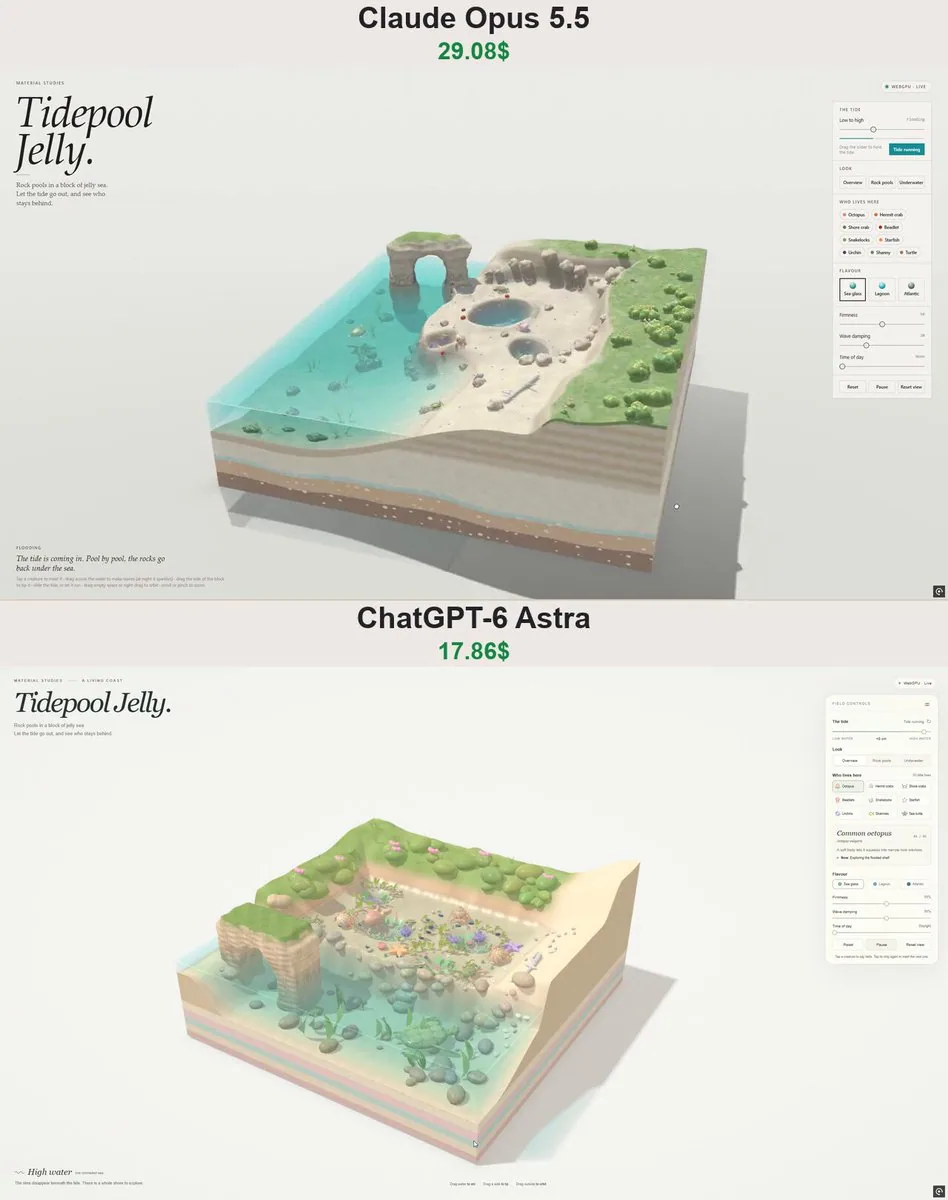
Create “Tidepool Jelly” - an interactive 3D miniature coastal ecosystem where everything feels soft, squishy, and made of translucent jelly.
Show an elevated, cutaway slice of coastline floating against a warm off-white background. Include layered sand and rock beneath the surface, shallow turquoise water, rocky tide pools, rounded pebbles, seashells, and small patches of coastal greenery. Use an orthographic camera with orbit and zoom controls.
Make the water the star of the scene: convincing waves, spreading ripples, reflections, refraction, underwater caustics, and a wet shoreline. Animate a rising and falling tide that fills and drains the pools. Clicking or dragging through water should create localized ripples that fade naturally.
Populate the pools with animated jelly sea creatures: tiny crabs, starfish, sea anemones, snails, mussels, shrimp, and small fish. Give each species distinct movement and behavior. Crabs scuttle around rocks, anemones sway with the current, snails crawl slowly, and fish swim in loose groups. Their bodies should gently wobble and deform as they move.
Let users click a creature to focus the camera and reveal a compact species card. Allow gentle interactions that trigger a squishy reaction, followed by a smooth return to the original shape.
Add a clean, minimal control panel with:
Tide height and automatic tide cycle.
Wave strength and water clarity.
Jelly softness.
Day and night lighting.
Species visibility toggles.
Pause, reset, and a randomize ecosystem button.
At night, introduce subtle bioluminescence in the water and selected creatures.
Use elegant editorial typography, generous whitespace, and restrained UI styling. Place the “Tidepool Jelly” title in the upper-left corner and controls on the right. The scene should dominate the screen.
Build a fully working browser experience using Three.js and custom shaders where useful. Prioritize beautiful water, believable creature movement, tactile jelly materials, and smooth performance. All controls must work. Avoid static mockups, placeholder assets, and oversized interface elements.